Interview
Time Management Interview Questions: Understanding Productivity, Prioritization, and Workplace Discipline
Dec 16, 2025

Introduction
Time is one of the most valuable resources in any workplace. Regardless of role or industry, every professional must allocate their time effectively to handle competing responsibilities, unexpected challenges, and shifting priorities. This is why organizations rely on time management interview questions to assess whether candidates possess the discipline, focus, and planning skills needed for consistent performance.
These questions reveal how candidates structure their work, how they respond under deadlines, and how they make decisions when tasks accumulate faster than they can complete them. Strong time management skills are essential for remote workers, hybrid teams, high-volume roles, and project-based environments where poor organization can break momentum and affect team output.
According to insights from Harvard Business Review, employees with strong time management habits are more productive, less stressed, and more consistent in collaborative environments. Modern companies know that functional time management is not simply about working harder; it is about working smarter and maintaining steady control over one’s workload.
Tools like Tener.AI help assess communication clarity during time management discussions—showing how candidates articulate processes, justify priorities, and describe decision-making under pressure. These linguistic cues provide valuable insight into how reliably a candidate can handle complex workflows and manage competing demands.
What Are Time Management Interview Questions?
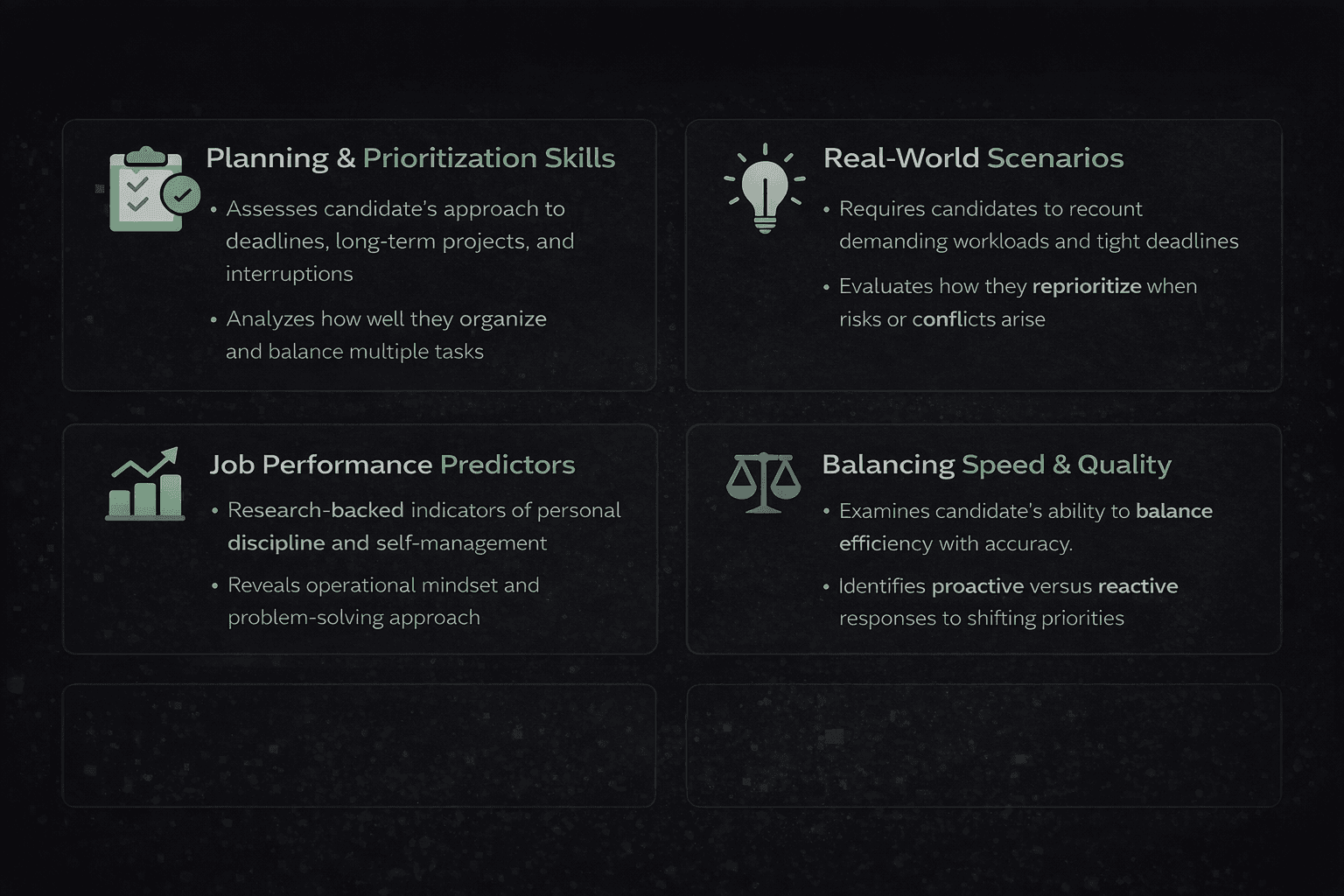
Time management interview questions are behavioral and situational questions designed to uncover how candidates plan, prioritize, and execute work. They explore a candidate’s approach to meeting deadlines, handling unexpected interruptions, organizing long-term projects, and balancing multiple tasks without sacrificing quality.
These questions go beyond asking whether a candidate is “organized.” They push applicants to describe real scenarios—moments when workloads were demanding, when a deadline was at risk, or when conflicting responsibilities required rapid reprioritization. Recruiters evaluate not only the outcome but also the reasoning behind the candidate’s choices. Did they anticipate risks? Did they communicate proactively? Did they adapt calmly or react impulsively?
Companies like Indeed note that time management questions are research-backed predictors of job performance because they reveal personal discipline, operational mindset, and self-awareness. They demonstrate how candidates manage themselves rather than how they respond to external instructions.
Time management answers also reveal whether candidates understand the balance between speed and quality. Some professionals rush tasks and compromise accuracy; others become overly meticulous and fall behind. The best answers demonstrate a candidate’s ability to create structure, maintain focus, allocate cognitive resources effectively, and recover when plans shift.
Additionally, these questions highlight communication habits. A candidate who communicates proactively during high-pressure situations reduces team risk; one who goes silent during overload can unintentionally create bottlenecks. Through detailed answers, recruiters gain insight into whether the candidate shares progress, escalates concerns, and collaborates effectively.
Why Time Management Interview Questions Matter
Time management defines how individuals translate their skills into results. No matter how talented someone is, poor organization or weak prioritization can lead to missed deadlines, inconsistent contributions, and preventable stress. This is why time management interview questions play a critical role in evaluating candidates for nearly every position.
Organizations rely on these questions to understand how well candidates handle high-volume workloads and unpredictable environments. Hiring managers observe the mental frameworks candidates use when tasks accumulate or when constraints appear. Research from LinkedIn Talent Solutions shows that time management, along with communication and adaptability, is one of the top competencies linked to high job performance.
These questions also uncover whether a candidate can operate autonomously. In hybrid and remote roles, employees often work without direct supervision. Poor time management can escalate quickly in these settings, leading to delays that impact entire teams. Strong time management answers show structured thinking, advanced planning habits, and the ability to maintain accountability across distance.
Time management questions matter because they provide insight into long-term reliability. Candidates who maintain consistency—through proactive planning, clear communication, and smart prioritization—contribute positively to team stability and operational flow. Conversely, candidates who struggle with time management often show irregular productivity, missed deadlines, and reactive work habits.
Finally, these questions reveal cultural alignment. Some organizations prioritize disciplined scheduling and strong predictability; others value flexibility and rapid reprioritization. Time management questions show whether candidates thrive in structured or dynamic environments. With tools like Tener.AI, recruiters can also evaluate how clearly and confidently candidates articulate their time management strategies in English, further enhancing assessment precision.
Reason These Questions Matter | What Recruiters Learn | Impact on Team Productivity | Value for Hiring Accuracy |
Understanding planning and prioritization habits | Reveals how candidates structure complex workloads. | Improves consistency in project execution. | Identifies reliable, disciplined workers. |
Evaluating stress and deadline response | Shows emotional stability under pressure. | Reduces risk of missed deadlines. | Predicts long-term performance stability. |
Assessing communication during overload | Reveals transparency and escalation habits. | Minimizes workflow disruptions. | Ensures alignment in hybrid teams. |
Determining adaptability | Shows how candidates adjust priorities. | Strengthens operational resilience. | Supports role fit across dynamic environments. |
Core Benefits of Using Time Management Interview Questions
Time management interview questions help organizations evaluate far more than organizational habits—they help reveal how candidates think. Strong answers demonstrate cognitive discipline, clarity of planning, and the ability to break down large goals into actionable steps. This analytical thinking often correlates with superior performance in roles requiring independent judgment.
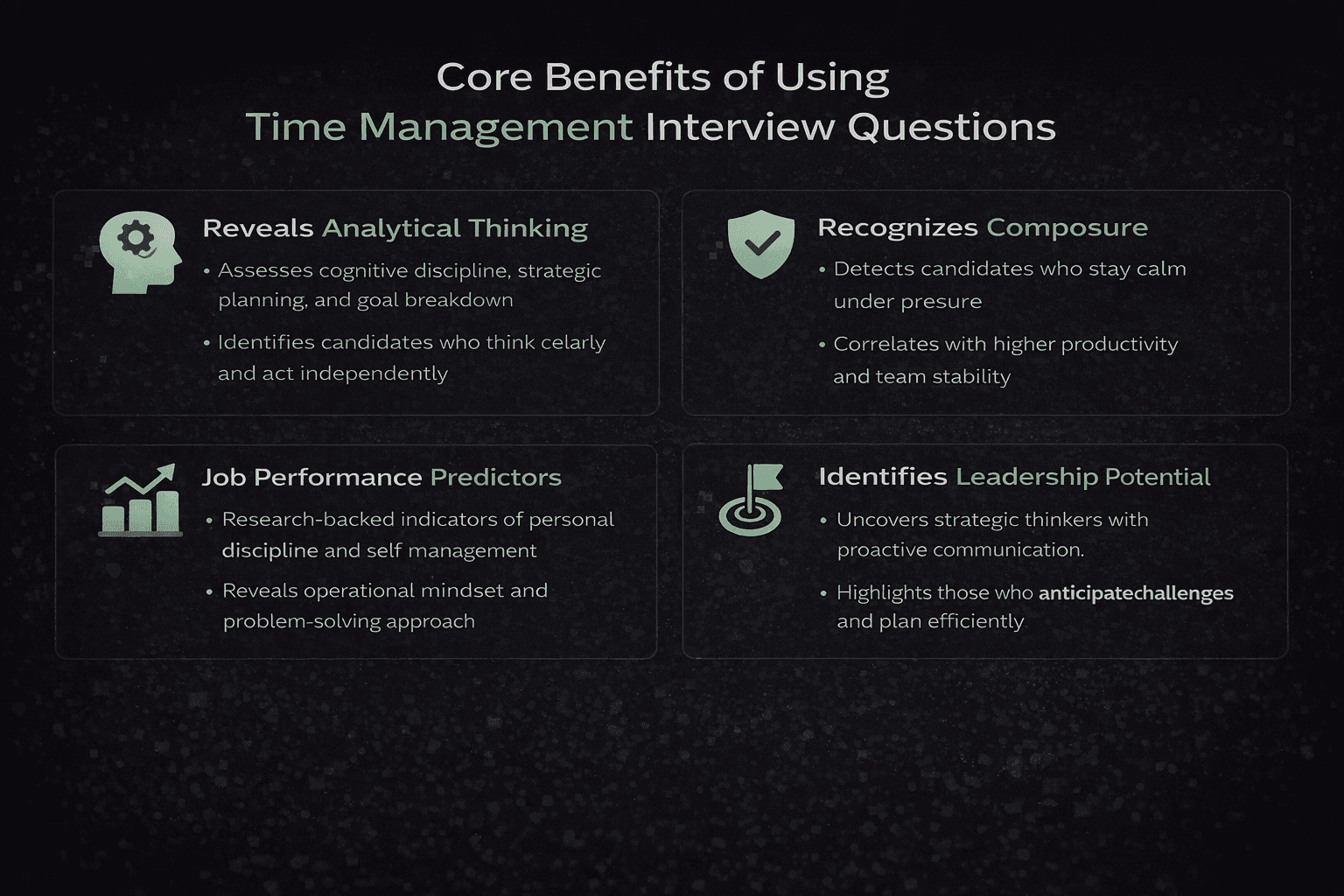
These questions also help employers recognize candidates who can maintain balance under pressure. When individuals remain composed during busy periods, they not only protect their own productivity but also contribute positively to team dynamics. As noted by SHRM, employees who manage time effectively also experience less burnout, leading to longer retention and higher overall performance.
Another major benefit is evaluating consistency. Time management questions reveal whether the candidate performs well occasionally or maintains steady output across long-term projects. Predictable workflow is essential for teams that depend on coordinated scheduling, especially across departments.
Time management questions highlight communication habits as well. Candidates who provide proactive updates and communicate early about risks reduce operational uncertainty. Their approach to sharing progress and adjusting expectations directly influences team stability and project flow.
Finally, these questions help employers identify leadership potential. Individuals who think clearly under pressure, anticipate obstacles, and allocate time strategically often grow into roles requiring oversight and operational planning. Tener.AI helps assess the clarity and structure of candidate communication—essential indicators of leadership readiness.
Real-World Examples Across Industries
Time management challenges appear across all industries, though the nature of the challenge varies widely. In technology, engineers and product managers often juggle simultaneous deadlines, cross-functional dependencies, and shifting project scopes. Strong time management in this context requires constant reprioritization, transparent communication, and the discipline to maintain focus despite frequent interruptions.
In healthcare, professionals must manage time in high-stakes environments where delays can directly affect patient care. Nurses, physicians, and administrators rely on precise scheduling, clear workflows, and rapid decision-making. Time management isn’t simply a productivity metric—it is a safety requirement.
In education, teachers and academic coordinators handle planning, content delivery, assessments, and evolving student needs simultaneously. Their ability to divide complex workloads into structured tasks determines both student experience and institutional efficiency.
Customer service professionals balance ongoing conversations, follow-ups, documentation, and escalations. Time management directly affects customer satisfaction, service consistency, and responsiveness.
In consultancy and professional services, time is tied directly to revenue. Consultants must manage client demands, internal responsibilities, research tasks, and deadlines with high accuracy. The ability to allocate time effectively determines profitability and client trust.
In hybrid and remote environments across all industries, time management becomes even more critical. Without physical oversight, professionals must self-regulate deadlines, structure their day proactively, and use digital tools effectively. According to Forbes, the most successful remote workers are those who establish strong internal discipline and maintain consistent communication—both essential topics covered by time management interview questions.
Across all sectors, employers use time management interview questions to reveal whether candidates adapt under pressure, maintain focus amid complexity, and contribute positively to team workflows.
Types of Time Management Interview Questions
Time management interview questions typically explore planning, prioritization, organization, and deadline execution. One type focuses on how candidates structure their workload. These questions ask candidates to describe how they organize multiple tasks, how they plan long-term commitments, and how they manage daily routines. Their answers reveal their approach to scheduling, their ability to anticipate obstacles, and their habit of aligning work with strategic objectives.
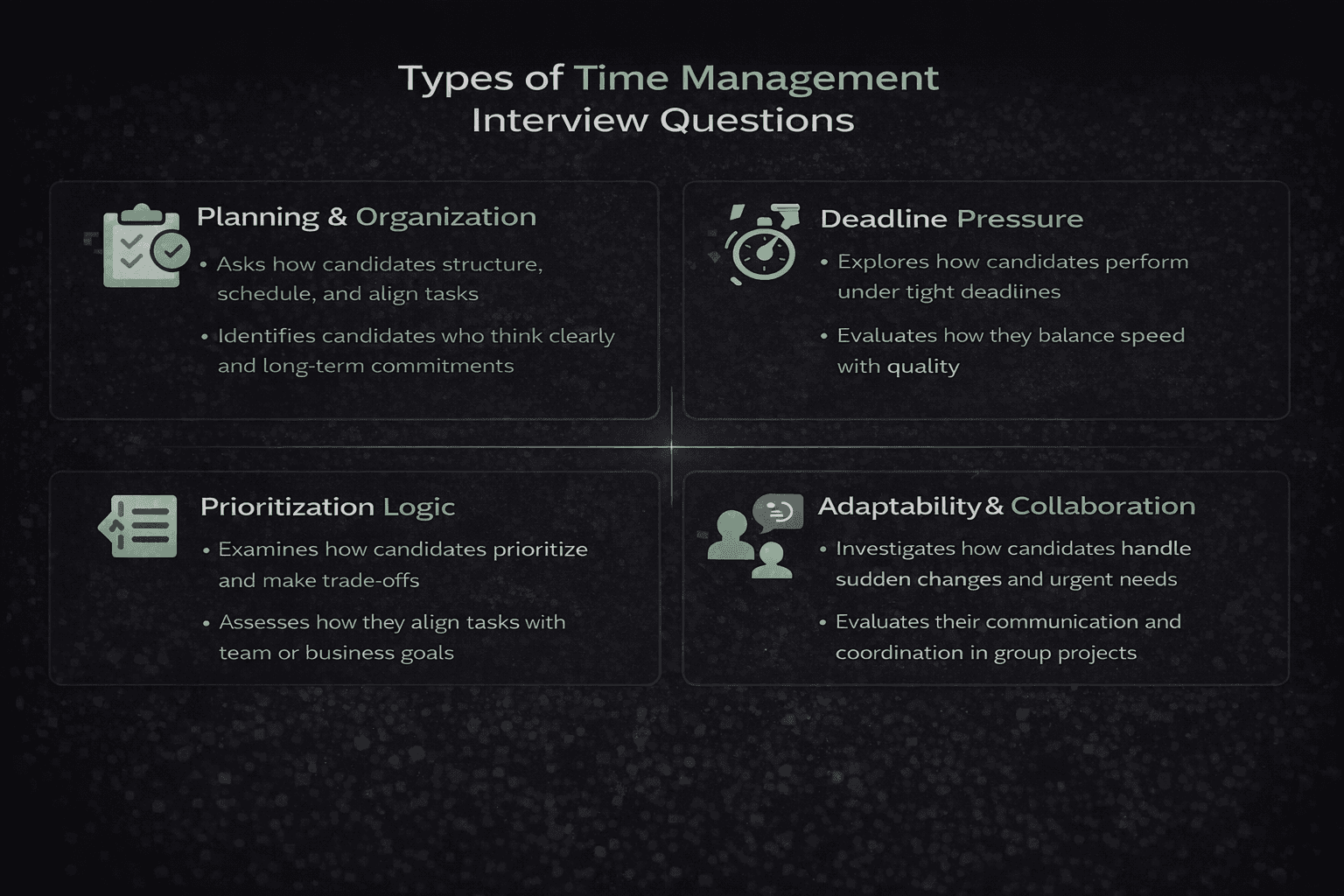
Another category explores deadline pressure. These questions focus on moments when candidates faced tight timelines or when deadlines converged unexpectedly. Recruiters examine how candidates maintained quality under pressure, whether they communicated risks early, and how they balanced speed with accuracy.
A third type investigates prioritization logic. Candidates must explain how they determine what to do first, how they negotiate conflicting priorities, and how they align tasks with team or business goals. Their reasoning reveals their strategic thinking and ability to differentiate urgent tasks from important ones.
Other questions explore adaptability: how candidates handle sudden changes, urgent requests, or disruptions. These questions uncover flexibility, emotional regulation, and resilience—qualities essential in fast-changing industries.
Some questions involve collaboration: how candidates communicate time constraints to others, negotiate deadlines, or coordinate timelines in group projects. Effective answers demonstrate transparency, diplomacy, and the ability to maintain constructive relationships even under pressure.
Through these categories, recruiters gain insight into a candidate’s overall productivity philosophy and workplace maturity.
How to Analyze Time Management Answers Effectively
Effective analysis of time management answers requires attention to reasoning, structure, emotional tone, and decision patterns. Interviewers observe whether candidates describe events clearly, logically, and with an understanding of both their responsibilities and the broader objectives. Candidates who struggle to articulate methods often lack consistent time management habits.
Evaluators also pay attention to whether candidates acknowledge mistakes or learning experiences. Professionals with strong time management skills are often self-aware; they understand when their systems failed and have adapted stronger strategies. According to insights from Harvard Business Review, reflective learning is one of the strongest predictors of time management improvement.
Recruiters analyze communication habits as well. Clear, structured responses indicate a disciplined mind; fragmented or overly lengthy answers may indicate poor organization. Tone also plays a role—professionals who remain calm while describing stressful deadlines demonstrate emotional composure.
Finally, tools like Tener.AI can analyze the clarity and coherence of candidate responses, offering valuable data on how well candidates communicate processes, prioritize tasks, and structure their workflow in English.
Trends and Innovations in Time Management Skill Evaluation
Modern companies increasingly use AI-driven tools, simulation exercises, and structured behavioral scoring to evaluate time management skills. Insights from Forbes indicate that AI-powered screening can identify linguistic signals that correlate with planning, clarity, and prioritization.
Scenario-based assessments simulate real workload conditions—multiple incoming tasks, unexpected changes, or conflicting deadlines. According to McKinsey & Company, simulation tests provide highly accurate predictions of time management performance because they reveal instinctive behavior.
Some organizations use digital collaboration tools in their assessments. Candidates may be asked to plan a project timeline, reprioritize tasks, or communicate schedule risks through chat or email. These methods evaluate how candidates coordinate time in hybrid environments.
Applicant tracking systems increasingly incorporate behavioral analytics, allowing companies to compare time management narratives across candidates. When combined with platforms like Tener.AI, recruiters gain a multidimensional understanding of time management competence.
Innovation | What It Evaluates | Recruiter Insight | Impact on Hiring Quality |
AI-Driven Interview Analysis | Clarity, structure, prioritization logic. | Shows how candidates think under workload pressure. | Improves objectivity and prediction accuracy. |
Workload Simulations | Real-time decision-making in high-volume tasks. | Reveals instinctive time management behavior. | Identifies high performers early. |
Digital Collaboration Assessments | Scheduling, updates, negotiation in hybrid teams. | Reflects real workplace conditions. | Improves remote-role hiring reliability. |
Behavioral Analytics in ATS | Patterns across time management narratives. | Highlights consistency and planning maturity. | Strengthens data-backed screening. |
Conclusion
Time management interview questions uncover the habits, strategies, and thought processes that shape workplace productivity. They reveal how candidates organize their time, prioritize tasks, communicate under pressure, and adjust when plans shift. These insights help companies hire professionals who work effectively, remain reliable during demanding periods, and strengthen team performance.
With a combination of storytelling, structured analysis, and AI-powered insights from tools like Tener.AI, recruiters can evaluate time management skills with greater accuracy and fairness. Strong time management contributes not only to individual success but also to the stability, efficiency, and long-term growth of organizations.
FAQ
What are time management interview questions?
They are behavioral questions used to evaluate how candidates plan, prioritize, and manage their workload.
Why do employers ask about time management?
Because time discipline affects productivity, reliability, collaboration, and deadline performance.
How do good candidates answer time management questions?
They demonstrate clear reasoning, structured planning, accountability, and adaptability.
Can time management skills be assessed through AI?
Yes. Tools like Tener.AI analyze clarity, structure, and communication patterns related to planning and prioritization.
Why is time management important in remote roles?
Remote professionals must self-regulate schedules, communicate proactively, and maintain consistency without supervision.
Introduction
Time is one of the most valuable resources in any workplace. Regardless of role or industry, every professional must allocate their time effectively to handle competing responsibilities, unexpected challenges, and shifting priorities. This is why organizations rely on time management interview questions to assess whether candidates possess the discipline, focus, and planning skills needed for consistent performance.
These questions reveal how candidates structure their work, how they respond under deadlines, and how they make decisions when tasks accumulate faster than they can complete them. Strong time management skills are essential for remote workers, hybrid teams, high-volume roles, and project-based environments where poor organization can break momentum and affect team output.
According to insights from Harvard Business Review, employees with strong time management habits are more productive, less stressed, and more consistent in collaborative environments. Modern companies know that functional time management is not simply about working harder; it is about working smarter and maintaining steady control over one’s workload.
Tools like Tener.AI help assess communication clarity during time management discussions—showing how candidates articulate processes, justify priorities, and describe decision-making under pressure. These linguistic cues provide valuable insight into how reliably a candidate can handle complex workflows and manage competing demands.
What Are Time Management Interview Questions?
Time management interview questions are behavioral and situational questions designed to uncover how candidates plan, prioritize, and execute work. They explore a candidate’s approach to meeting deadlines, handling unexpected interruptions, organizing long-term projects, and balancing multiple tasks without sacrificing quality.
These questions go beyond asking whether a candidate is “organized.” They push applicants to describe real scenarios—moments when workloads were demanding, when a deadline was at risk, or when conflicting responsibilities required rapid reprioritization. Recruiters evaluate not only the outcome but also the reasoning behind the candidate’s choices. Did they anticipate risks? Did they communicate proactively? Did they adapt calmly or react impulsively?
Companies like Indeed note that time management questions are research-backed predictors of job performance because they reveal personal discipline, operational mindset, and self-awareness. They demonstrate how candidates manage themselves rather than how they respond to external instructions.
Time management answers also reveal whether candidates understand the balance between speed and quality. Some professionals rush tasks and compromise accuracy; others become overly meticulous and fall behind. The best answers demonstrate a candidate’s ability to create structure, maintain focus, allocate cognitive resources effectively, and recover when plans shift.
Additionally, these questions highlight communication habits. A candidate who communicates proactively during high-pressure situations reduces team risk; one who goes silent during overload can unintentionally create bottlenecks. Through detailed answers, recruiters gain insight into whether the candidate shares progress, escalates concerns, and collaborates effectively.
Why Time Management Interview Questions Matter
Time management defines how individuals translate their skills into results. No matter how talented someone is, poor organization or weak prioritization can lead to missed deadlines, inconsistent contributions, and preventable stress. This is why time management interview questions play a critical role in evaluating candidates for nearly every position.
Organizations rely on these questions to understand how well candidates handle high-volume workloads and unpredictable environments. Hiring managers observe the mental frameworks candidates use when tasks accumulate or when constraints appear. Research from LinkedIn Talent Solutions shows that time management, along with communication and adaptability, is one of the top competencies linked to high job performance.
These questions also uncover whether a candidate can operate autonomously. In hybrid and remote roles, employees often work without direct supervision. Poor time management can escalate quickly in these settings, leading to delays that impact entire teams. Strong time management answers show structured thinking, advanced planning habits, and the ability to maintain accountability across distance.
Time management questions matter because they provide insight into long-term reliability. Candidates who maintain consistency—through proactive planning, clear communication, and smart prioritization—contribute positively to team stability and operational flow. Conversely, candidates who struggle with time management often show irregular productivity, missed deadlines, and reactive work habits.
Finally, these questions reveal cultural alignment. Some organizations prioritize disciplined scheduling and strong predictability; others value flexibility and rapid reprioritization. Time management questions show whether candidates thrive in structured or dynamic environments. With tools like Tener.AI, recruiters can also evaluate how clearly and confidently candidates articulate their time management strategies in English, further enhancing assessment precision.
Reason These Questions Matter | What Recruiters Learn | Impact on Team Productivity | Value for Hiring Accuracy |
Understanding planning and prioritization habits | Reveals how candidates structure complex workloads. | Improves consistency in project execution. | Identifies reliable, disciplined workers. |
Evaluating stress and deadline response | Shows emotional stability under pressure. | Reduces risk of missed deadlines. | Predicts long-term performance stability. |
Assessing communication during overload | Reveals transparency and escalation habits. | Minimizes workflow disruptions. | Ensures alignment in hybrid teams. |
Determining adaptability | Shows how candidates adjust priorities. | Strengthens operational resilience. | Supports role fit across dynamic environments. |
Core Benefits of Using Time Management Interview Questions
Time management interview questions help organizations evaluate far more than organizational habits—they help reveal how candidates think. Strong answers demonstrate cognitive discipline, clarity of planning, and the ability to break down large goals into actionable steps. This analytical thinking often correlates with superior performance in roles requiring independent judgment.
These questions also help employers recognize candidates who can maintain balance under pressure. When individuals remain composed during busy periods, they not only protect their own productivity but also contribute positively to team dynamics. As noted by SHRM, employees who manage time effectively also experience less burnout, leading to longer retention and higher overall performance.
Another major benefit is evaluating consistency. Time management questions reveal whether the candidate performs well occasionally or maintains steady output across long-term projects. Predictable workflow is essential for teams that depend on coordinated scheduling, especially across departments.
Time management questions highlight communication habits as well. Candidates who provide proactive updates and communicate early about risks reduce operational uncertainty. Their approach to sharing progress and adjusting expectations directly influences team stability and project flow.
Finally, these questions help employers identify leadership potential. Individuals who think clearly under pressure, anticipate obstacles, and allocate time strategically often grow into roles requiring oversight and operational planning. Tener.AI helps assess the clarity and structure of candidate communication—essential indicators of leadership readiness.
Real-World Examples Across Industries
Time management challenges appear across all industries, though the nature of the challenge varies widely. In technology, engineers and product managers often juggle simultaneous deadlines, cross-functional dependencies, and shifting project scopes. Strong time management in this context requires constant reprioritization, transparent communication, and the discipline to maintain focus despite frequent interruptions.
In healthcare, professionals must manage time in high-stakes environments where delays can directly affect patient care. Nurses, physicians, and administrators rely on precise scheduling, clear workflows, and rapid decision-making. Time management isn’t simply a productivity metric—it is a safety requirement.
In education, teachers and academic coordinators handle planning, content delivery, assessments, and evolving student needs simultaneously. Their ability to divide complex workloads into structured tasks determines both student experience and institutional efficiency.
Customer service professionals balance ongoing conversations, follow-ups, documentation, and escalations. Time management directly affects customer satisfaction, service consistency, and responsiveness.
In consultancy and professional services, time is tied directly to revenue. Consultants must manage client demands, internal responsibilities, research tasks, and deadlines with high accuracy. The ability to allocate time effectively determines profitability and client trust.
In hybrid and remote environments across all industries, time management becomes even more critical. Without physical oversight, professionals must self-regulate deadlines, structure their day proactively, and use digital tools effectively. According to Forbes, the most successful remote workers are those who establish strong internal discipline and maintain consistent communication—both essential topics covered by time management interview questions.
Across all sectors, employers use time management interview questions to reveal whether candidates adapt under pressure, maintain focus amid complexity, and contribute positively to team workflows.
Types of Time Management Interview Questions
Time management interview questions typically explore planning, prioritization, organization, and deadline execution. One type focuses on how candidates structure their workload. These questions ask candidates to describe how they organize multiple tasks, how they plan long-term commitments, and how they manage daily routines. Their answers reveal their approach to scheduling, their ability to anticipate obstacles, and their habit of aligning work with strategic objectives.
Another category explores deadline pressure. These questions focus on moments when candidates faced tight timelines or when deadlines converged unexpectedly. Recruiters examine how candidates maintained quality under pressure, whether they communicated risks early, and how they balanced speed with accuracy.
A third type investigates prioritization logic. Candidates must explain how they determine what to do first, how they negotiate conflicting priorities, and how they align tasks with team or business goals. Their reasoning reveals their strategic thinking and ability to differentiate urgent tasks from important ones.
Other questions explore adaptability: how candidates handle sudden changes, urgent requests, or disruptions. These questions uncover flexibility, emotional regulation, and resilience—qualities essential in fast-changing industries.
Some questions involve collaboration: how candidates communicate time constraints to others, negotiate deadlines, or coordinate timelines in group projects. Effective answers demonstrate transparency, diplomacy, and the ability to maintain constructive relationships even under pressure.
Through these categories, recruiters gain insight into a candidate’s overall productivity philosophy and workplace maturity.
How to Analyze Time Management Answers Effectively
Effective analysis of time management answers requires attention to reasoning, structure, emotional tone, and decision patterns. Interviewers observe whether candidates describe events clearly, logically, and with an understanding of both their responsibilities and the broader objectives. Candidates who struggle to articulate methods often lack consistent time management habits.
Evaluators also pay attention to whether candidates acknowledge mistakes or learning experiences. Professionals with strong time management skills are often self-aware; they understand when their systems failed and have adapted stronger strategies. According to insights from Harvard Business Review, reflective learning is one of the strongest predictors of time management improvement.
Recruiters analyze communication habits as well. Clear, structured responses indicate a disciplined mind; fragmented or overly lengthy answers may indicate poor organization. Tone also plays a role—professionals who remain calm while describing stressful deadlines demonstrate emotional composure.
Finally, tools like Tener.AI can analyze the clarity and coherence of candidate responses, offering valuable data on how well candidates communicate processes, prioritize tasks, and structure their workflow in English.
Trends and Innovations in Time Management Skill Evaluation
Modern companies increasingly use AI-driven tools, simulation exercises, and structured behavioral scoring to evaluate time management skills. Insights from Forbes indicate that AI-powered screening can identify linguistic signals that correlate with planning, clarity, and prioritization.
Scenario-based assessments simulate real workload conditions—multiple incoming tasks, unexpected changes, or conflicting deadlines. According to McKinsey & Company, simulation tests provide highly accurate predictions of time management performance because they reveal instinctive behavior.
Some organizations use digital collaboration tools in their assessments. Candidates may be asked to plan a project timeline, reprioritize tasks, or communicate schedule risks through chat or email. These methods evaluate how candidates coordinate time in hybrid environments.
Applicant tracking systems increasingly incorporate behavioral analytics, allowing companies to compare time management narratives across candidates. When combined with platforms like Tener.AI, recruiters gain a multidimensional understanding of time management competence.
Innovation | What It Evaluates | Recruiter Insight | Impact on Hiring Quality |
AI-Driven Interview Analysis | Clarity, structure, prioritization logic. | Shows how candidates think under workload pressure. | Improves objectivity and prediction accuracy. |
Workload Simulations | Real-time decision-making in high-volume tasks. | Reveals instinctive time management behavior. | Identifies high performers early. |
Digital Collaboration Assessments | Scheduling, updates, negotiation in hybrid teams. | Reflects real workplace conditions. | Improves remote-role hiring reliability. |
Behavioral Analytics in ATS | Patterns across time management narratives. | Highlights consistency and planning maturity. | Strengthens data-backed screening. |
Conclusion
Time management interview questions uncover the habits, strategies, and thought processes that shape workplace productivity. They reveal how candidates organize their time, prioritize tasks, communicate under pressure, and adjust when plans shift. These insights help companies hire professionals who work effectively, remain reliable during demanding periods, and strengthen team performance.
With a combination of storytelling, structured analysis, and AI-powered insights from tools like Tener.AI, recruiters can evaluate time management skills with greater accuracy and fairness. Strong time management contributes not only to individual success but also to the stability, efficiency, and long-term growth of organizations.
FAQ
What are time management interview questions?
They are behavioral questions used to evaluate how candidates plan, prioritize, and manage their workload.
Why do employers ask about time management?
Because time discipline affects productivity, reliability, collaboration, and deadline performance.
How do good candidates answer time management questions?
They demonstrate clear reasoning, structured planning, accountability, and adaptability.
Can time management skills be assessed through AI?
Yes. Tools like Tener.AI analyze clarity, structure, and communication patterns related to planning and prioritization.
Why is time management important in remote roles?
Remote professionals must self-regulate schedules, communicate proactively, and maintain consistency without supervision.

" height="80.94400020599366px" id="qIjvZtSLI" transform="translate(0 12.275)" width="373.7409916992187px"/><path d="M 0 9.975 C 0 7.247 0.974 4.902 2.919 2.942 C 4.949 0.981 7.361 0 10.152 0 C 12.858 0 15.228 0.938 17.259 2.814 C 19.287 4.689 20.302 6.991 20.302 9.719 C 20.302 12.447 19.287 14.791 17.259 16.752 C 15.311 18.712 12.943 19.692 10.152 19.692 C 8.799 19.692 7.488 19.437 6.219 18.926 C 5.054 18.427 3.982 17.735 3.046 16.88 C 2.101 16.007 1.326 14.966 0.761 13.81 C 0.251 12.596 -0.008 11.292 0 9.975 Z" fill="rgb(34, 191, 89)" height="19.691999999999993px" id="yONhdWkLI" transform="translate(289.772 72.503)" width="20.30220185337174px"/><path d="M 15.225 0.001 L 0 0.001 L 0 61.38 L 15.225 61.38 L 15.225 0 Z" fill="rgb(245, 245, 245)" height="61.38px" id="D4KrqKylr" transform="translate(387.929 30.049)" width="15.225000000000023px"/><path d="M 0 9.207 C 0 6.735 0.888 4.603 2.664 2.813 C 4.526 0.938 6.852 0 9.643 0 C 12.435 0 14.761 0.895 16.622 2.685 C 18.567 4.39 19.541 6.565 19.541 9.207 C 19.541 11.85 18.567 14.066 16.622 15.857 C 14.761 17.561 12.435 18.414 9.643 18.414 C 6.852 18.414 4.526 17.518 2.664 15.728 C 0.888 13.853 0 11.679 0 9.207 Z" fill="rgb(245, 245, 245)" height="18.414px" id="Qi52r923l" transform="translate(385.771 0)" width="19.54099999999994px"/></g></svg>)