Communication
Speech Practice: Building Confident Communication Skills for Personal and Professional Success
Dec 16, 2025

Introduction
Speech practice has become an essential skill for professionals seeking to improve their communication, clarity, and confidence. Whether interacting with colleagues, presenting ideas to leadership, interviewing for new roles, or building a global career, effective speech determines how well individuals connect with others and how convincingly they express their thoughts. Strong speaking abilities influence credibility, trust, collaboration, and leadership potential.
Communication is no longer limited to face-to-face interactions. Today’s professional environment includes virtual meetings, presentations on video calls, asynchronous voice notes, and remote collaboration across time zones. This shift has increased demand for people who can communicate clearly and confidently in diverse contexts. According to insights from Harvard Business Review, verbal communication quality significantly affects perceptions of competence and leadership readiness.
Speech practice helps individuals refine pronunciation, improve fluency, strengthen articulation, and elevate overall expressiveness. It trains the brain to organize thoughts logically and deliver messages with clarity. For non-native speakers working in English, speech practice provides an additional advantage—building comfort with vocabulary, phrasing, and grammar structures through active use. Tools like Tener.AI support this process by analyzing clarity, coherence, and language patterns in spoken responses, helping learners build confidence and accuracy over time.
This article explores what speech practice truly involves, why it matters, how it strengthens communication skills, and how individuals and organizations can integrate effective practice into learning or professional development programs.
What Is Speech Practice?
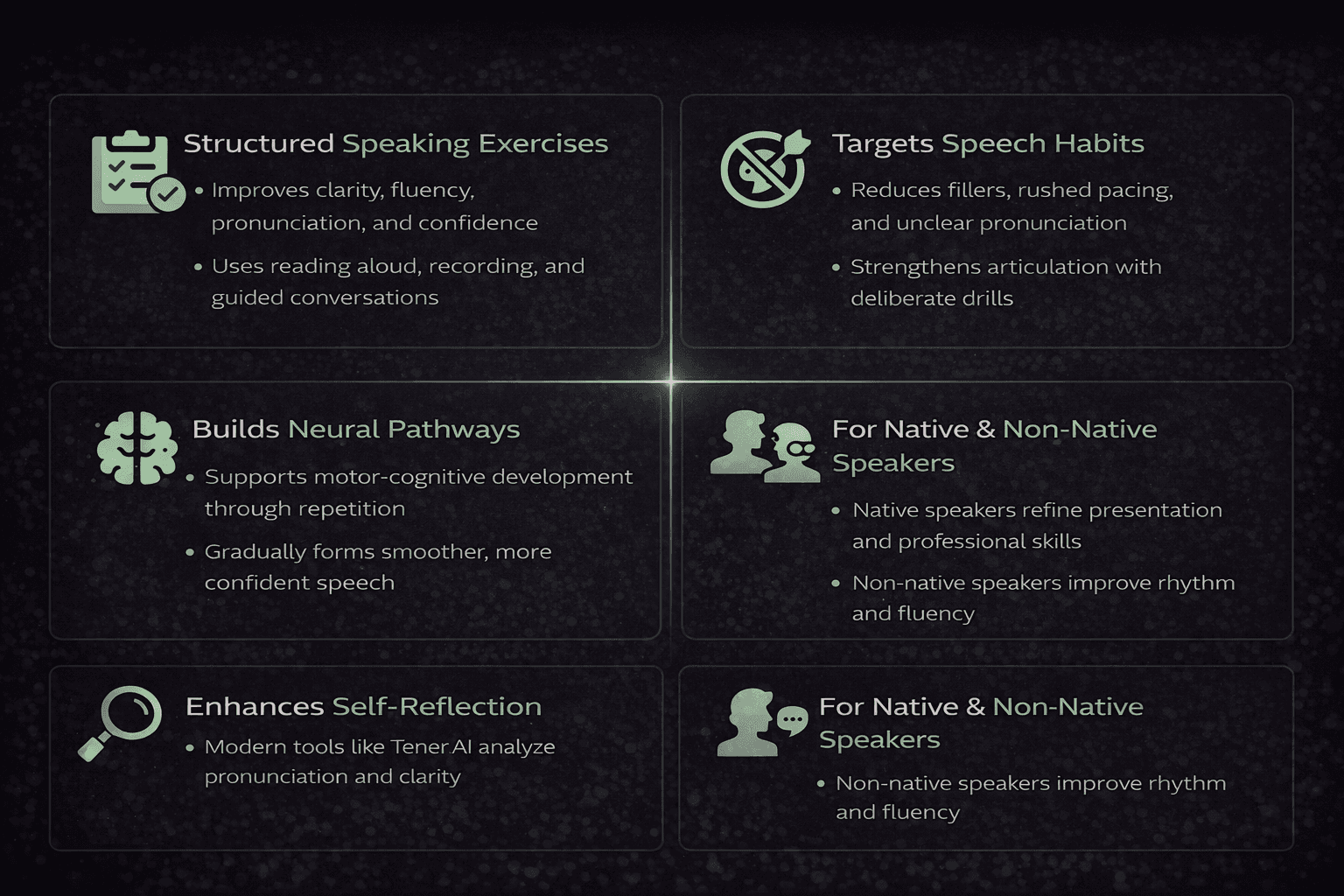
Speech practice is the structured development of speaking skills through repeated, intentional exercises. It focuses on improving clarity, fluency, pronunciation, pacing, vocabulary use, and confidence during spoken communication. Unlike everyday conversation, which happens spontaneously, speech practice uses deliberate repetition and reflection to build stronger verbal habits.
It involves multiple techniques, such as reading aloud, recording oneself to analyze speaking patterns, participating in guided conversations, practicing presentations, and engaging in structured drills designed to strengthen articulation and pacing. These exercises help individuals overcome speech habits that interfere with clarity, including filler words, rushed pacing, unclear pronunciation, or fragmented sentences.
According to the educational research from Stanford University, speaking is a motor-cognitive activity—meaning that consistent, targeted practice strengthens neural pathways that support fluent communication. Through training, individuals gradually develop smoother, more confident speech patterns, allowing them to express complex ideas without hesitation.
Speech practice is valuable for both native and non-native speakers. Native speakers often need practice to reduce informal habits, improve presentation skills, or adapt communication styles for professional settings. Non-native speakers focus on accuracy, rhythm, lexical precision, and fluency. In both cases, structured speech practice turns communication into a polished, intentional skill that supports professional growth.
Modern tools like Tener.AI provide an additional layer of support by analyzing pronunciation, clarity, sentence structure, and overall fluency. This combination of real-time feedback and self-reflection allows individuals to accelerate progress far more effectively than through practice alone.
Why Speech Practice Matters
Speech practice is critical because verbal communication is one of the most visible reflections of professional competence. How individuals speak shapes how others perceive their intelligence, confidence, emotional stability, and leadership potential. Research published by Forbes shows that clear communication significantly influences hiring outcomes, performance evaluations, and promotion opportunities.
Speech practice matters because it enhances clarity. When individuals articulate ideas precisely, misunderstandings decrease, collaboration improves, and decision-making becomes more efficient. In many industries—technology, healthcare, consulting, customer service, education—clear speech can directly impact productivity and trust.
Another reason speech practice matters is confidence building. People who practice speaking regularly experience lower levels of communication anxiety, especially during presentations or meetings. This confidence empowers them to speak up more frequently, share ideas more openly, and influence discussions more effectively.
Speech practice is also essential for non-native speakers navigating English-speaking workplaces. Pronunciation clarity, rhythm, and oral fluency affect how well individuals are understood. According to LinkedIn Talent Solutions, strong English speaking skills significantly increase access to global opportunities, cross-border projects, and leadership roles.
Finally, speech practice matters because communication is central to leadership. Leaders who speak clearly inspire trust, set direction effectively, and build stronger team alignment. Practicing speech helps individuals develop a communication presence that supports leadership growth. With support from AI-powered tools such as Tener.AI, individuals can refine their speaking patterns with data-backed insights that accelerate improvement.
Reason Speech Practice Matters | What It Improves | Recruiter/Employer Insight | Professional Impact |
Clarity in communication | Articulation, pacing, pronunciation | Shows ability to convey ideas effectively | Reduces misunderstandings and strengthens collaboration |
Confidence building | Public speaking, self-expression | Reflects readiness for leadership roles | Improves meeting participation and presentation quality |
Workplace efficiency | Cohesion, structured responses | Shows professional maturity | Enhances productivity across teams |
Global communication skills | Fluency, accuracy, rhythm | Indicates ability to work in multilingual teams | Expands international career opportunities |
Core Benefits of Regular Speech Practice
One of the most immediate benefits of speech practice is improved fluency. Through repeated verbal exercises, individuals strengthen the mental pathways that support spontaneous communication. This allows them to speak smoothly, maintain consistent pacing, and reduce hesitations during important conversations.
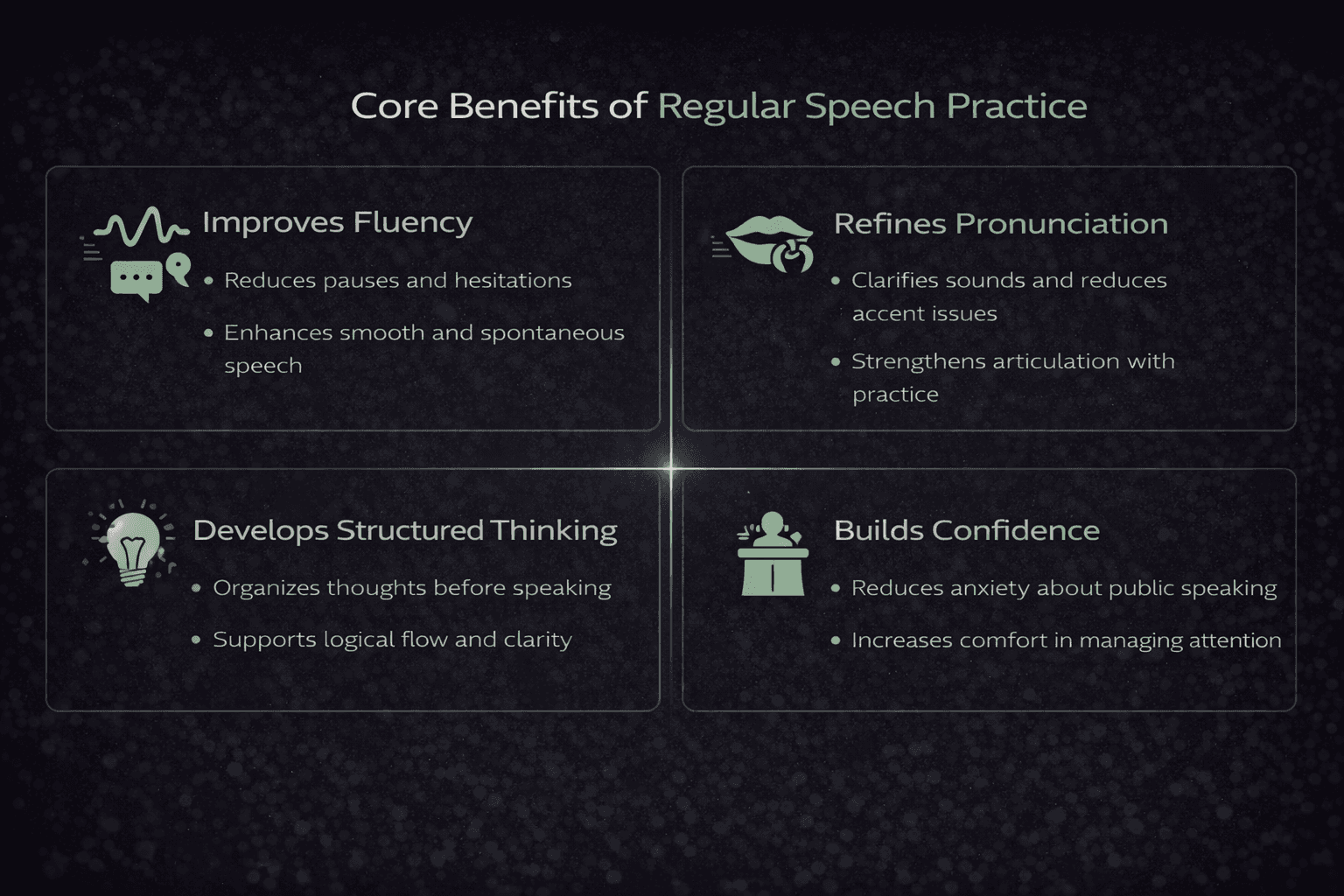
Speech practice also enhances pronunciation. By focusing on the sounds and rhythms of English, speakers refine articulation and reduce accent-related misunderstandings. This does not mean eliminating personal speech identity but rather ensuring clarity strong enough to support high-level professional communication.
Another benefit is the development of structured thinking. When individuals practice speaking, they learn to organize ideas before expressing them. This leads to clearer explanations, more persuasive conversations, and stronger logical flow during presentations. Research from Harvard University shows that verbal structuring exercises improve cognitive processing and communication performance.
Speech practice also strengthens interpersonal communication. Individuals who practice speaking become more aware of tone, emotional nuance, and conversational pacing. This leads to smoother interactions with colleagues, clients, and team members.
Finally, speech practice reduces public speaking anxiety. The more individuals rehearse out loud, the more comfortable they become managing attention, articulating ideas, and maintaining composure. Over time, this confidence transforms communication from a source of stress into a professional advantage.
Real-World Examples Across Industries
In customer service, speech practice helps employees express empathy, manage tone, and communicate solutions clearly. Successful communication directly influences customer satisfaction, brand loyalty, and service recovery. Many service organizations integrate structured speech practice into training programs to ensure consistency and professionalism.
In technology, professionals use speech practice to improve clarity during cross-functional discussions. Engineers, product managers, and designers must communicate complex ideas efficiently. Speech practice helps them simplify technical information for stakeholders, clients, or leadership teams.
In healthcare, clear and confident speech is essential for safety. Nurses, physicians, and administrators must communicate medical information, instructions, and risks with accuracy. Speech practice equips healthcare professionals with the clarity and confidence needed to reduce errors and improve patient outcomes.
In education, teachers rely on speech practice to deliver lessons effectively, maintain engagement, and adjust communication styles for diverse learners. Strong verbal clarity improves classroom dynamics and enhances student comprehension.
In international business environments, speech practice is indispensable. Professionals must communicate across cultural and linguistic differences. Practicing English speech enhances their ability to collaborate globally, participate in international meetings, and contribute confidently to multinational teams. Tener.AI supports this by analyzing speech patterns and consistency, giving learners precise feedback to refine their communication skills.
Types of Speech Practice
Speech practice can take multiple forms, each serving a unique purpose. One common type is structured reading aloud, which helps speakers develop consistent pacing, refine pronunciation, and increase vocal confidence. Reading complex texts trains the mind to process language quickly while speaking smoothly.
Another type involves self-recording. Individuals record themselves speaking and review the audio to identify unclear articulation, filler words, or rushed speech. This reflective method accelerates improvements by making subconscious habits visible.
Conversational drills are another essential category. These involve guided or semi-guided discussions designed to strengthen verbal spontaneity. They help individuals practice responding to questions, articulating opinions, and engaging in real-time dialogue.
Presentation rehearsal is also a powerful form of speech practice. By practicing speeches or pitch scripts, individuals develop clear messaging, stronger transitions, and greater confidence. These exercises improve clarity and control during high-pressure scenarios.
Finally, role-play practice simulates professional situations: job interviews, client meetings, negotiations, or team updates. These simulations help individuals prepare for real workplace communication demands and develop confidence when speaking in dynamic or unpredictable environments.
How to Analyze Speaking Skills Effectively
Evaluating speech requires attention to both linguistic and non-linguistic cues. Recruiters, educators, and managers assess clarity, fluency, tone, organization, and emotional expression. Clear articulation shows precision; smooth pacing shows emotional control; structured responses show cognitive organization.
Evaluators listen for logical flow—whether the speaker connects ideas naturally, uses transitions effectively, and maintains coherence. They assess filler words, hesitations, and over-complex phrasing, which may indicate a lack of confidence or preparation.
Tone and emotional presence are equally important. Speech practice helps individuals manage their tone to sound composed, professional, and respectful. Professionals with strong speaking skills project calmness even when discussing complex topics.
AI-powered tools like Tener.AI enhance evaluation by analyzing linguistic clarity, pronunciation consistency, and verbal structure. These insights help learners understand their strengths and weaknesses with accuracy and objectivity.
Trends and Innovations in Speech Practice
Modern speech development is influenced by neuroscience, AI, remote communication needs, and global workforce expansion. One major trend is the rise of AI-assisted speech training. According to Forbes, AI tools significantly improve language acquisition and speaking confidence by analyzing articulation, fluency, and coherence in real time.
Another trend is micro-practice—short, frequent speech exercises. Research from McKinsey & Company shows that skill micro-practice leads to faster improvement than long, infrequent sessions.
Remote communication has also changed how people practice speech. Many companies now incorporate virtual speaking simulations to prepare employees for online meetings, webinars, and global presentations.
Additionally, pronunciation and prosody training has gained popularity. These methods focus on rhythm, stress, and intonation, helping speakers sound more natural and engaging. They also reduce misunderstandings caused by unclear speech patterns.
Finally, speech practice now integrates cognitive training. By pairing verbal exercises with memory or logic tasks, learners strengthen mental agility and improve spontaneous expression.
Trend | What It Enhances | Recruiter/Educator Insight | Impact on Speech Development |
AI-assisted speech analysis | Pronunciation, clarity, fluency | Shows objective communication competence | Accelerates improvement through feedback |
Micro-practice routines | Consistency, memory, pacing | Indicates disciplined learning habits | Builds stable long-term fluency |
Virtual practice environments | Remote communication confidence | Prepares individuals for online interactions | Improves digital meeting performance |
Prosody and intonation training | Expressiveness and natural rhythm | Reflects advanced speaking maturity | Enhances engagement and clarity |
How Businesses Can Integrate Speech Practice
Organizations increasingly recognize speech practice as a critical part of professional development. Businesses integrate speech training to improve internal communication, leadership pipelines, and customer-facing performance. Leaders often require strong speaking skills to align teams, communicate strategic direction, and maintain trust.
Businesses can integrate speech practice through presentation workshops, communication coaching, pronunciation sessions, and simulated client-interaction exercises. These programs build confidence and equip employees with practical skills tailored to their roles.
Many organizations also use speech practice during onboarding to help new hires adapt to internal communication norms. In global teams, speech training enhances cross-cultural collaboration and reduces misunderstandings.
AI tools like Tener.AI support corporate speech development by giving employees private, non-judgmental practice environments where they can refine clarity and fluency before engaging in real workplace scenarios.
Challenges and Mistakes to Avoid
One of the most common challenges in speech practice is inconsistency. Many individuals practice intensively for a short period and then stop. Without regular reinforcement, improvements decline.
Another mistake is focusing too much on perfection. Overthinking leads to anxiety, stiff delivery, and unnatural speech patterns. Effective speech practice emphasizes clarity and confidence over flawless pronunciation.
A frequent challenge for non-native speakers is comparing themselves to native speakers. This leads to frustration and demotivation. The goal of speech practice is clear, professional communication—not native-like speech.
Finally, many learners avoid recording themselves because it feels uncomfortable. However, self-recording is one of the most effective ways to identify speech habits and track improvement.
How to Choose a Speech Practice Tool or Program
When selecting a speech practice program, individuals and businesses should prioritize clarity of methodology and relevance to real communication contexts. A strong speech practice tool should provide structured feedback, opportunities for repetition, and analysis focused on clarity, fluency, and expression.
Organizations should also consider whether the tool supports global communication needs. Tools like Tener.AI are designed to analyze English speech used in professional contexts, making them suitable for hybrid teams and international collaboration.
Flexibility is another important criterion. The best tools accommodate different learning styles by offering multiple practice formats—conversation, narration, presentation, and pronunciation.
Finally, the tool should offer measurable progress tracking. Consistent data helps individuals see improvement over time and adjust practice strategies effectively.
Section | Purpose | Key Insight | Professional Impact |
Definition | Explains what speech practice involves | Shows structured development of speaking skills | Establishes foundation for communication improvement |
Importance | Highlights why speech practice matters | Shows link between communication and workplace success | Improves collaboration, leadership, and clarity |
Benefits | Demonstrates advantages of consistent practice | Reveals fluency, confidence, and articulation gains | Enhances long-term career growth |
Industry Examples | Shows relevance across sectors | Aligns speech skills with real job demands | Strengthens workforce communication quality |
Types of Practice | Outlines practice categories | Provides multi-angle development methods | Expands verbal and cognitive communication skills |
Speech Analysis | Explains how to evaluate speaking | Uses tone, clarity, and structure as indicators | Improves hiring and training precision |
Trends & Innovations | Explores modern tools and methods | Shows impact of AI and digital practice | Accelerates communication skill development |
Business Integration | Shows how companies implement speech training | Links communication to organizational performance | Strengthens internal culture and leadership pipelines |
Conclusion
Speech practice is one of the most valuable investments a professional can make in their communication abilities. Strong speaking skills improve clarity, confidence, collaboration, leadership presence, and career potential. Through consistent practice—supported by scientific insights, structured exercises, and AI-driven analysis—individuals transform communication from a challenge into a strategic advantage.
Whether preparing for interviews, leading teams, presenting ideas, or navigating global workplaces, speech practice equips individuals with the tools needed to express themselves clearly and confidently. With modern platforms like Tener.AI, the path to stronger communication has never been more accessible or effective.
FAQ
What is speech practice?
Speech practice is the structured development of verbal communication through exercises that improve clarity, fluency, and expression.
Why is speech practice important?
Because clear communication influences trust, collaboration, professional credibility, and leadership potential.
How often should I practice speaking?
Consistent short sessions several times a week are more effective than infrequent long sessions.
Is speech practice only for non-native speakers?
No. Native speakers also practice to improve clarity, reduce filler words, and refine professional communication.
Can AI help with speech practice?
Yes. Tools like Tener.AI analyze pronunciation, fluency, and structure, offering data-driven feedback for improvement.
Does speech practice improve confidence?
Absolutely. Regular practice reduces anxiety, enhances presence, and builds stronger communication habits.

" height="80.94400020599366px" id="qIjvZtSLI" transform="translate(0 12.275)" width="373.7409916992187px"/><path d="M 0 9.975 C 0 7.247 0.974 4.902 2.919 2.942 C 4.949 0.981 7.361 0 10.152 0 C 12.858 0 15.228 0.938 17.259 2.814 C 19.287 4.689 20.302 6.991 20.302 9.719 C 20.302 12.447 19.287 14.791 17.259 16.752 C 15.311 18.712 12.943 19.692 10.152 19.692 C 8.799 19.692 7.488 19.437 6.219 18.926 C 5.054 18.427 3.982 17.735 3.046 16.88 C 2.101 16.007 1.326 14.966 0.761 13.81 C 0.251 12.596 -0.008 11.292 0 9.975 Z" fill="rgb(34, 191, 89)" height="19.691999999999993px" id="yONhdWkLI" transform="translate(289.772 72.503)" width="20.30220185337174px"/><path d="M 15.225 0.001 L 0 0.001 L 0 61.38 L 15.225 61.38 L 15.225 0 Z" fill="rgb(245, 245, 245)" height="61.38px" id="D4KrqKylr" transform="translate(387.929 30.049)" width="15.225000000000023px"/><path d="M 0 9.207 C 0 6.735 0.888 4.603 2.664 2.813 C 4.526 0.938 6.852 0 9.643 0 C 12.435 0 14.761 0.895 16.622 2.685 C 18.567 4.39 19.541 6.565 19.541 9.207 C 19.541 11.85 18.567 14.066 16.622 15.857 C 14.761 17.561 12.435 18.414 9.643 18.414 C 6.852 18.414 4.526 17.518 2.664 15.728 C 0.888 13.853 0 11.679 0 9.207 Z" fill="rgb(245, 245, 245)" height="18.414px" id="Qi52r923l" transform="translate(385.771 0)" width="19.54099999999994px"/></g></svg>)