AI Recruiting
AI Recruiting Assistant: Transforming Hiring Through Intelligent Automation and Data-Driven Insights
Dec 16, 2025

Introduction
The rapid evolution of recruitment technology has reshaped how companies attract, evaluate, and select candidates. Among the most influential innovations is the AI recruiting assistant, a digital tool that supports and automates key parts of the hiring process. From screening resumes to analyzing interviews to forecasting candidate fit, AI-powered recruiting assistants allow organizations to hire more effectively while reducing manual workload and improving decision-making.
As talent markets become more competitive and roles increasingly require hybrid, remote, and multilingual communication, recruiters face tremendous pressure to work faster without sacrificing quality. Traditional hiring methods often struggle to keep up with high application volumes, complex evaluation criteria, and the need for unbiased selection. Research from Harvard Business Review notes that companies leveraging AI in hiring achieve stronger shortlists, faster screening cycles, and more consistent evaluation outcomes.
AI recruiting assistants do not replace human expertise. Instead, they enhance it. They streamline the administrative burden, provide deeper analytical insights, and make the hiring process more predictable and scalable. For multilingual teams, tools like Tener.AI support clear communication assessments by analyzing linguistic clarity and structure during interviews, helping companies evaluate language-dependent competencies with higher precision.
This article explores what an AI recruiting assistant is, how it works, why it matters, and how businesses integrate these systems to strengthen their hiring strategy.
What Is an AI Recruiting Assistant?
An AI recruiting assistant is an intelligent software system designed to help organizations automate and optimize recruitment tasks. It uses machine learning, natural language processing, and predictive analytics to analyze candidate information, support communication workflows, evaluate suitability, and assist recruiters in making informed decisions.
These assistants perform functions such as screening resumes, analyzing job descriptions, generating interview questions, evaluating candidate responses, scheduling interviews, and supporting candidate engagement. They transform disparate pieces of candidate data into structured insights that help recruiters understand patterns, competencies, and readiness.
According to insights from McKinsey & Company, organizations that deploy AI assistants in talent acquisition reduce time-to-hire significantly while improving match accuracy between candidate skills and job requirements. AI systems interpret large volumes of information far faster than human recruiters, identifying underlying competencies, communication patterns, and behavioral indicators with high precision.
AI recruiting assistants are not limited to resume parsing. Modern systems can analyze candidate speech, writing style, soft skills, and reasoning patterns. Tools like Tener.AI contribute additional value by evaluating English language clarity and communication quality—two factors critical for global collaboration.
In essence, an AI recruiting assistant acts as a data-driven partner throughout the recruitment lifecycle, helping companies make better decisions based on evidence rather than intuition.
Why AI Recruiting Assistants Matter
AI recruiting assistants matter because they address some of the most persistent challenges in talent acquisition. Hiring teams often struggle with overwhelming candidate volume, inconsistent evaluation standards, communication bottlenecks, and human bias. AI systems offer structure, consistency, and analytical depth that support stronger hiring outcomes.
One major reason they matter is efficiency. Recruiters frequently spend hours reviewing resumes, filtering candidates, and coordinating interviews. AI assistants automate these tasks, allowing human recruiters to focus on deeper evaluation and relationship-building. Research published by LinkedIn Talent Solutions shows that companies using AI tools accelerate screening processes while maintaining or enhancing quality.
AI also enhances fairness and consistency in hiring. Human evaluations can be subjective and influenced by cognitive biases, unconscious preferences, or fatigue. AI systems evaluate candidates based on data rather than assumptions. When properly designed, they reduce biased interpretations and help companies select candidates based on competency, communication clarity, and job alignment.
Another reason AI assistants matter is their predictive capability. By analyzing historical hiring data and job success patterns, these tools help forecast which candidates may become high-performing employees. This predictive ability allows organizations to build stronger teams and reduce turnover.
AI recruiting assistants also support hybrid and remote hiring environments. Many candidates now participate in virtual interviews or complete asynchronous assessments. AI tools analyze communication patterns, adaptability, and clarity—factors essential for remote work. Platforms like Tener.AI help companies evaluate English-speaking skills in real time, offering objective feedback for roles requiring strong communication.
Finally, AI recruiting assistants matter because they prepare organizations for future workforce needs. As roles evolve, businesses need tools that can adapt quickly to new skill sets, emerging technologies, and shifting market demands.
Reason They Matter | What AI Enhances | Recruiter Insight | Impact on Hiring Quality |
Efficiency and speed | Screening, scheduling, pre-evaluation | Frees time for strategic decision-making | Shortens time-to-hire significantly |
Consistency and fairness | Standardized evaluation criteria | Reduces subjective bias in early screening | Enhances diversity and accuracy |
Predictive hiring success | Data-driven performance forecasting | Shows long-term fit indicators | Reduces turnover and mismatch risk |
Hybrid and remote readiness | Communication and adaptability analysis | Reveals clarity and collaboration potential | Improves selection for global teams |
Core Benefits of Using an AI Recruiting Assistant
One key benefit of an AI recruiting assistant is the ability to process and analyze information at scale. Recruiters often face hundreds or thousands of applications for a single job. AI systems filter these efficiently, ensuring that no qualified candidate is overlooked and that hiring teams receive a curated, high-quality shortlist.
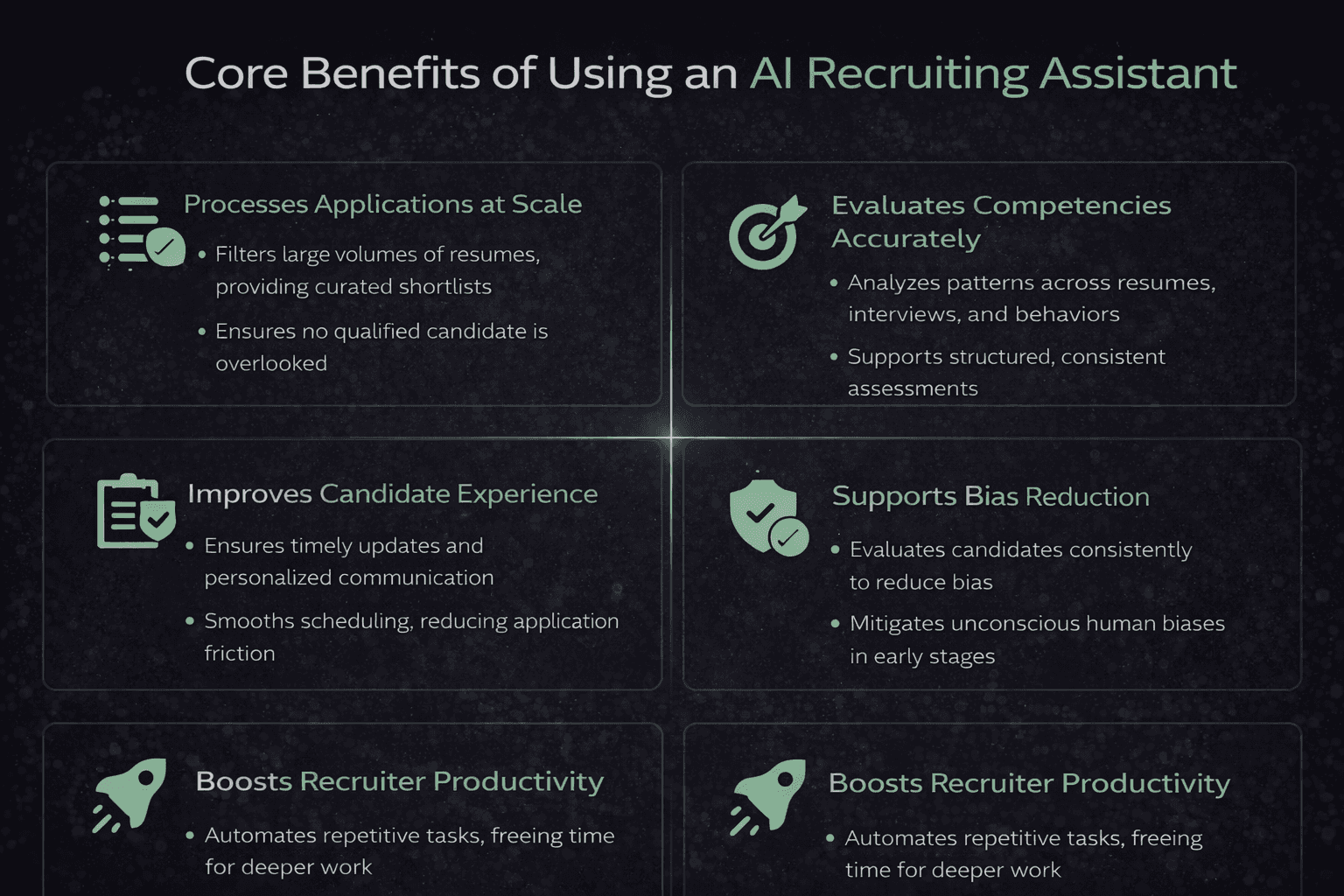
Another benefit is improved accuracy in evaluating competencies. While human recruiters rely on intuition and experience, AI tools analyze patterns across resumes, interview responses, and behavioral cues. This multi-layered analysis supports more consistent candidate evaluations. Research from SHRM emphasizes that structured, data-supported assessments improve prediction accuracy for job performance.
Candidate experience also benefits from AI recruiting assistants. These systems ensure timely updates, personalized communication, and smoother scheduling. Candidates appreciate faster responses and clarity throughout the application timeline. AI-driven chat and email workflows reduce frustration, improving employer brand perception.
Another core benefit is bias reduction. AI tools evaluate candidates consistently, reducing the influence of unconscious human biases that often affect early hiring stages. When combined with ethical oversight, these systems support more equitable hiring decisions.
AI assistants also help assess communication skills with greater depth. For roles requiring strong verbal clarity or English proficiency, platforms like Tener.AI provide objective analysis of language structure, clarity, and fluency, contributing to more accurate communication evaluation.
Finally, AI recruiting assistants enhance recruiter productivity. By automating manual tasks, they enable human experts to focus on high-impact work such as interviewing, relationship-building, and culture assessment.
Real-World Examples Across Industries
The impact of AI recruiting assistants is visible across industries. In technology, companies use AI systems to identify candidates with the right combination of experience and problem-solving capability. AI screening helps detect coding patterns, domain knowledge, and communication skills critical for engineering roles. Tech companies often adopt AI systems early due to large applicant pools and competitive hiring timelines.
In healthcare, AI recruiting assistants help identify candidates with specialized certifications, patient-care experience, and communication clarity. Hospitals and clinics use AI tools to analyze resumes, prioritize essential qualifications, and streamline hiring for high-demand roles.
In finance and banking, AI systems evaluate candidates’ analytical skills, compliance background, attention to detail, and communication quality. These organizations require error-free decision-making, and AI helps identify patterns associated with reliability and performance.
In education, institutions use AI assistants to assess teaching experience, instructional style, and communication ability. Speech analysis tools like Tener.AI provide additional support for evaluating candidates who will teach or present information.
In retail and hospitality, high-volume hiring makes AI essential. AI recruiting assistants help filter seasonal staff, assess customer service communication skills, and streamline onboarding processes.
Across global business sectors, companies using AI assistants achieve greater hiring transparency, increased productivity, and more effective team-building.
Types of AI Recruiting Assistants
AI recruiting assistants come in various forms, each serving a distinct purpose within the hiring workflow. Some focus on sourcing candidates by scanning public profiles, identifying relevant skills, and matching individuals to openings. These sourcing assistants use predictive algorithms to determine which candidates might be a strong fit.
Others specialize in resume analysis. They evaluate work history, skill relevance, employment patterns, and linguistic cues. Advanced resume parsers differentiate between meaningful experience and inflated descriptions, giving recruiters a clearer picture of candidate potential.
Some AI assistants focus on communication analysis. They assess written or spoken language to determine clarity, tone, logical structure, and confidence. Tools like Tener.AI analyze English-speaking clarity, providing objective insights into communication skills essential for global roles.
Interview automation assistants support scheduling, coordination, and initial assessment. They handle logistics such as calendar integration, confirmations, and reminders, reducing administrative burden.
Predictive analytics assistants analyze historical hiring data to forecast which candidates are most likely to succeed. These systems consider past performance indicators, organizational culture alignment, and competency patterns.
Each type of AI assistant enhances a different part of the hiring cycle, contributing to a comprehensive, intelligent recruiting system.
How to Analyze AI-Supported Candidate Insights
Analyzing candidate insights provided by AI requires a balance of data interpretation and human judgment. AI systems offer structured evaluations, highlighting patterns in communication, competency alignment, and behavioral responses. Recruiters must interpret this information in context without relying exclusively on algorithmic output.
One important aspect is understanding how AI evaluates communication. For example, platforms like Tener.AI assess clarity, structure, and linguistic coherence, helping recruiters identify whether candidates can articulate ideas effectively. This insight becomes especially important for roles requiring presentations, client communication, or team leadership.
Recruiters also examine AI-generated skill maps, which show how well a candidate aligns with job requirements. Rather than taking these scores at face value, hiring teams should compare them with behavioral interview performance, references, and cultural fit assessments.
It is equally important to recognize potential model limitations. AI tools must be used ethically and transparently. Recruiters should always validate AI insights through human interviews, ensuring that data enhances rather than replaces human judgment.
When used correctly, AI insights enrich the evaluation process, helping teams make informed, balanced hiring decisions.
Trends and Innovations in AI Recruiting Assistants
AI recruiting assistants evolve quickly as machine learning models become more sophisticated. One emerging trend is conversational AI interviewing, where candidates interact with AI-driven interview tools that evaluate communication, reasoning, and clarity. According to insights from Forbes, conversational AI improves candidate experience by providing flexible, on-demand interviews.
Another trend is multimodal evaluation. AI tools increasingly analyze not only text but also speech patterns, timing, and cognitive signals. This multidimensional analysis gives recruiters a deeper understanding of emotional intelligence, confidence, and communication style.
Additionally, predictive analytics continues to grow. Companies integrate AI with performance data to refine models that forecast employee success. This approach creates a feedback loop that improves hiring accuracy over time.
A significant innovation is bias-detection technology. AI systems now include algorithms that identify whether hiring patterns indicate unintentional bias. This supports fairer, more compliant recruitment processes.
Finally, integration with collaboration platforms enhances adoption. AI assistants that integrate with ATS systems, messaging tools, and productivity platforms streamline hiring workflows and ensure smoother communication among stakeholders.
Innovation | What It Adds | Recruiter Benefit | Impact on Hiring Strategy |
Conversational AI interviews | Real-time communication analysis | Reveals reasoning and clarity | Improves early-stage evaluation |
Multimodal assessment | Speech, text, and behavioral signals | Deeper understanding of soft skills | Strengthens candidate predictions |
Predictive analytics | Future performance forecasting | Reduces hiring risk | Enhances long-term workforce planning |
Bias detection algorithms | Pattern analysis for fairness | Supports ethical hiring | Improves DE&I outcomes |
How Businesses Can Integrate an AI Recruiting Assistant
Integrating an AI recruiting assistant into the hiring process requires thoughtful planning, alignment with business goals, and clear communication across teams. Companies begin by identifying pain points in their current recruitment workflow, such as long screening cycles, high application volume, or inconsistent evaluation criteria.
Organizations then select tools that match their needs—resume parsing, communication assessment, scheduling automation, or predictive analysis. Platforms like Tener.AI integrate easily with existing systems, providing communication clarity insights that support global teams and roles requiring advanced English proficiency.
Businesses must also train hiring teams to use AI insights effectively. Recruiters should understand how AI evaluates candidates, how scoring works, and how to interpret data responsibly. According to insights from Harvard Business Review, companies that combine AI with skilled human judgment achieve the strongest hiring outcomes.
Integration involves maintaining transparency with candidates. Employers should communicate how AI supports the process while ensuring fairness and compliance with ethical guidelines.
When implemented strategically, AI recruiting assistants streamline hiring, improve accuracy, and enable businesses to scale talent acquisition sustainably.
Challenges and Mistakes to Avoid
One challenge companies face is over-reliance on automation. While AI provides powerful insights, final hiring decisions must incorporate human judgment. Over-automation risks overlooking personal attributes that software cannot fully interpret.
Another mistake is poor model training. AI systems require high-quality data to make accurate predictions. Incorrect or biased training data can lead to flawed outcomes. Companies must audit their data sources regularly to ensure ethical performance.
A common challenge is lack of recruiter training. Implementing AI without educating hiring teams results in misinterpretation of insights. Recruiters must understand the strengths and limitations of AI tools.
Finally, businesses should avoid implementing too many tools at once. Effective integration requires gradual adoption, process refinement, and stakeholder buy-in.
How to Choose an AI Recruiting Assistant
Selecting the right AI recruiting assistant requires assessing organizational needs and evaluating tool capabilities. Companies should prioritize platforms that provide transparency, explainability, and alignment with job requirements. AI tools must produce actionable insights, not opaque metrics.
Businesses should also assess integration capabilities. A strong AI recruiting assistant should connect seamlessly with ATS systems, HR platforms, and communication tools.
Another factor is communication evaluation. For roles requiring strong spoken English, tools like Tener.AI provide essential clarity analysis that helps recruiters make informed decisions about global candidates.
Scalability matters as well. Organizations should choose AI systems capable of growing with their hiring needs.
Finally, compliance and fairness are critical. AI recruiting assistants must be designed with ethical safeguards and clear documentation to support unbiased hiring.
Section | Purpose | Insight for Recruiters | Impact on Hiring Outcomes |
Definition | Explains what AI recruiting assistants do | Clarifies their role across hiring stages | Establishes foundation for tool selection |
Importance | Shows why AI is essential for modern hiring | Highlights efficiency, fairness, and accuracy | Strengthens team capability and scalability |
Benefits | Detail core advantages | Supports evidence-based decisions | Improves quality of hire |
Industry Examples | Demonstrates relevance across sectors | Provides benchmarks for adoption | Aligns AI with real-world needs |
Assistant Types | Describes categories of AI tools | Clarifies functions and capabilities | Supports tailored hiring strategies |
Insight Analysis | Explains how to interpret AI results | Combines data with human expertise | Improves evaluation fairness |
Trends & Innovations | Explores modern advancements | Shows future potential of AI | Guides long-term recruitment strategy |
Business Integration | Shows how to implement AI | Ensures smooth adoption | Improves operational efficiency |
Conclusion
AI recruiting assistants are reshaping the future of hiring by offering efficiency, accuracy, and deeper analytical insights. They streamline workflows, improve candidate evaluation, and enable recruiters to focus on building meaningful connections rather than handling repetitive tasks. When combined with human expertise and tools like Tener.AI, which provide objective communication clarity analysis, AI recruiting assistants elevate the hiring process to a new level of intelligence and fairness.
Organizations that adopt AI recruiting assistants gain a competitive advantage in attracting top talent, making smarter decisions, and building resilient, high-performing teams.
FAQ
What is an AI recruiting assistant?
It is an intelligent software system that automates and supports tasks such as screening, communication analysis, scheduling, and decision-making.
Does AI replace human recruiters?
No. AI enhances human decision-making by providing faster and more accurate insights.
How does AI reduce bias in hiring?
By applying consistent evaluation criteria and minimizing subjective influence during early screening.
Can AI evaluate communication skills?
Yes. Tools like Tener.AI analyze clarity, structure, and linguistic patterns in spoken English.
Is AI useful for remote hiring?
Absolutely. AI helps evaluate communication, adaptability, and collaboration readiness in virtual environments.
What industries benefit from AI recruiting assistants?
All major industries, including tech, healthcare, finance, hospitality, and education.

" height="80.94400020599366px" id="qIjvZtSLI" transform="translate(0 12.275)" width="373.7409916992187px"/><path d="M 0 9.975 C 0 7.247 0.974 4.902 2.919 2.942 C 4.949 0.981 7.361 0 10.152 0 C 12.858 0 15.228 0.938 17.259 2.814 C 19.287 4.689 20.302 6.991 20.302 9.719 C 20.302 12.447 19.287 14.791 17.259 16.752 C 15.311 18.712 12.943 19.692 10.152 19.692 C 8.799 19.692 7.488 19.437 6.219 18.926 C 5.054 18.427 3.982 17.735 3.046 16.88 C 2.101 16.007 1.326 14.966 0.761 13.81 C 0.251 12.596 -0.008 11.292 0 9.975 Z" fill="rgb(34, 191, 89)" height="19.691999999999993px" id="yONhdWkLI" transform="translate(289.772 72.503)" width="20.30220185337174px"/><path d="M 15.225 0.001 L 0 0.001 L 0 61.38 L 15.225 61.38 L 15.225 0 Z" fill="rgb(245, 245, 245)" height="61.38px" id="D4KrqKylr" transform="translate(387.929 30.049)" width="15.225000000000023px"/><path d="M 0 9.207 C 0 6.735 0.888 4.603 2.664 2.813 C 4.526 0.938 6.852 0 9.643 0 C 12.435 0 14.761 0.895 16.622 2.685 C 18.567 4.39 19.541 6.565 19.541 9.207 C 19.541 11.85 18.567 14.066 16.622 15.857 C 14.761 17.561 12.435 18.414 9.643 18.414 C 6.852 18.414 4.526 17.518 2.664 15.728 C 0.888 13.853 0 11.679 0 9.207 Z" fill="rgb(245, 245, 245)" height="18.414px" id="Qi52r923l" transform="translate(385.771 0)" width="19.54099999999994px"/></g></svg>)