IELTS
IELTS Speaking Test: Mastering Fluency, Confidence, and Communication in 2025
Dec 16, 2025

Introduction
The IELTS speaking test remains one of the most influential assessments of English communication skills in the world. As global hiring expands, universities and employers increasingly prioritize candidates who can communicate clearly, confidently, and naturally. The speaking component of IELTS evaluates precisely these qualities—making it not just a language test, but a real measure of how effectively someone can operate in an English-speaking environment.
In 2025, the demand for clear, effective spoken communication is stronger than ever. Remote work, online collaboration, and multilingual teams make verbal clarity essential for academic success and global employment. The IELTS speaking test evaluates not only your grammar and vocabulary, but your ability to deliver ideas smoothly, handle unpredictable questions, and express yourself with confidence.
With advanced tools like Tener.AI, learners can now simulate speaking environments and receive real-time feedback on fluency, coherence, pronunciation, and lexical range—making preparation more accurate and customized. Whether you're a student, a professional, or a newcomer integrating into an English-speaking country, mastering the IELTS speaking test opens doors to better opportunities.
What Is the IELTS Speaking Test?
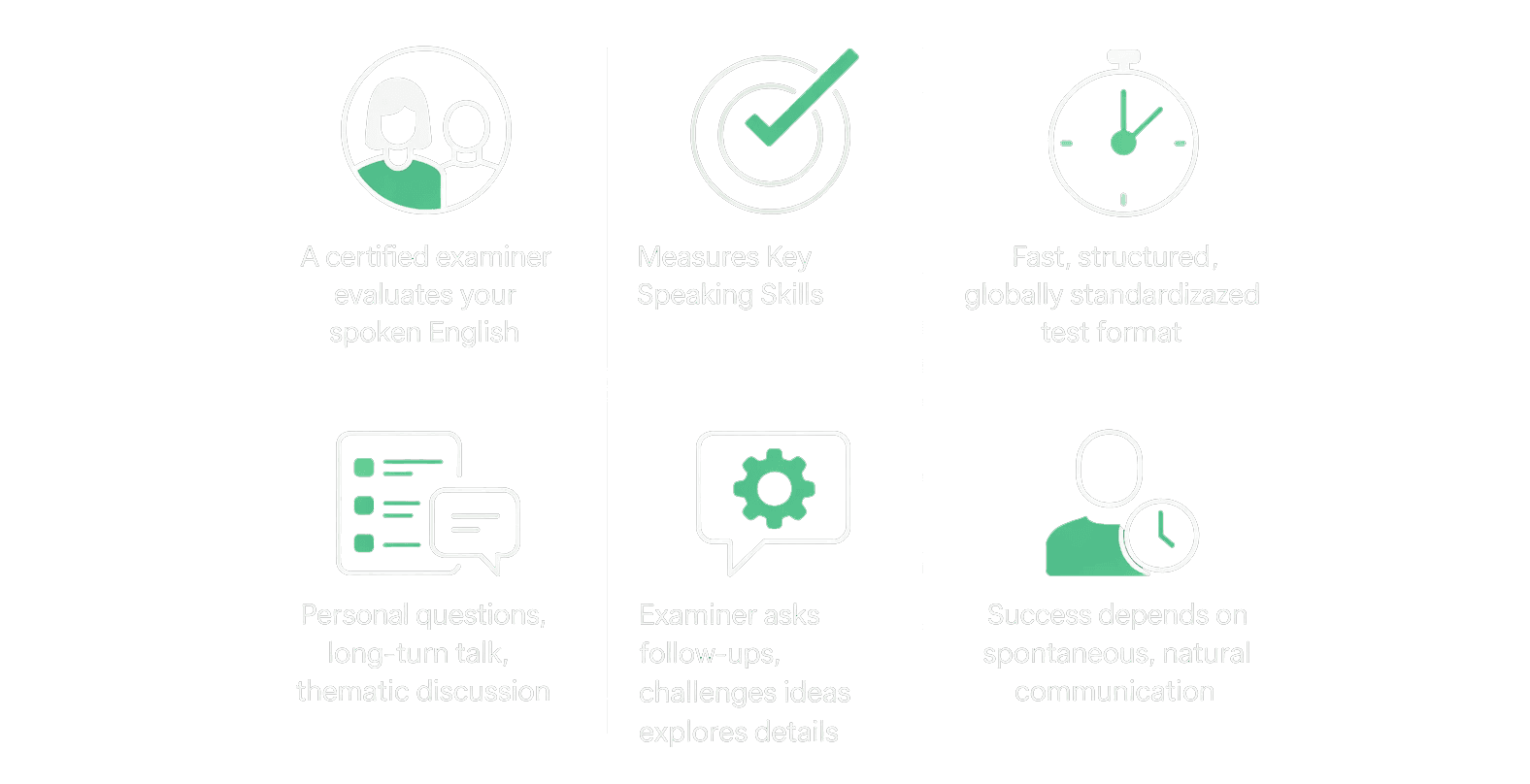
The IELTS speaking test is a face-to-face or video-call assessment conducted by a certified examiner. According to Cambridge Assessment English, the test evaluates how well you communicate in English by measuring fluency, coherence, lexical resource, grammatical range, and pronunciation. The speaking section lasts 11–14 minutes and is structured into three distinct parts:
A personal interview with general questions.
A long-turn monologue based on a cue card.
A deeper discussion exploring abstract or complex themes.
Unlike many other language assessments, the IELTS speaking test is interactive and adaptive. The examiner may ask follow-up questions, challenge your ideas, or invite you to elaborate. This conversational format is designed to mimic authentic English communication.
The test’s structure and scoring are standardized globally, supported by guidelines established through partnerships with British Council and IDP: IELTS Australia. Because of this strict standardization, preparation requires more than memorized answers—it demands an ability to think and respond in real time.
Why the IELTS Speaking Test Matters in 2025
The importance of spoken English continues to grow across industries and regions. The rapid expansion of online education, digital nomadism, and international job markets means that English is often the shared operational language among global teams. According to Harvard Business Review, communication competence is now one of the strongest predictors of cross-cultural performance and employability.
Academic institutions also rely heavily on IELTS scores to ensure that students can participate effectively in seminars, internships, and presentations. For many programs, a strong speaking score is a requirement—not an option.
Moreover, companies increasingly recognize that miscommunication leads to operational inefficiencies, reduced productivity, and unnecessary conflict. This is why many organizations incorporate English communication assessments into their hiring processes, particularly for client-facing positions.
In this context, the IELTS speaking test is no longer merely an academic formality; it is a gateway to international mobility, higher education, and career advancement.
Key Benefits of IELTS Speaking Proficiency
The ability to perform well in the IELTS speaking test brings several advantages. First, it validates your readiness for real-world communication. Unlike written exams, speaking assessments reveal how naturally you can handle spontaneous English conversations.
Second, it demonstrates adaptability. Examiners may shift topics, introduce abstract questions, or request clarifications—testing not only your language skills but also your ability to think on your feet.
Third, a strong speaking score increases your credibility in academic and professional environments. Programs and employers often view strong speakers as more confident, more collaborative, and more capable in multicultural settings.
Lastly, with tools like Tener.AI providing personalized practice environments, candidates can identify their weaknesses—such as hesitations, filler words, unclear phrasing, or limited vocabulary—and improve them in a structured way before the exam.
Benefit Category | Description | Impact on IELTS Score | Real-World Relevance |
Fluency & Coherence | The ability to speak continuously, logically, and without unnecessary hesitation. | Higher fluency scores and more natural performance in long-turn tasks. | Improves communication in professional and academic settings. |
Lexical Resource | A diverse vocabulary to express nuanced ideas with precision. | Boosts lexical scores, especially in Part 3 discussions. | Supports advanced communication, presentations, and public speaking. |
Pronunciation Clarity | Clear articulation, appropriate stress, and natural intonation patterns. | Enhances pronunciation scores and overall intelligibility. | Essential for remote work, international teamwork, and client interaction. |
Adaptability in Conversation | The ability to adjust answers, expand ideas, and react to follow-up questions. | Shows examiner readiness for complex question types. | Reflects real-life conversational competence and emotional intelligence. |
Detailed Breakdown of the IELTS Speaking Format
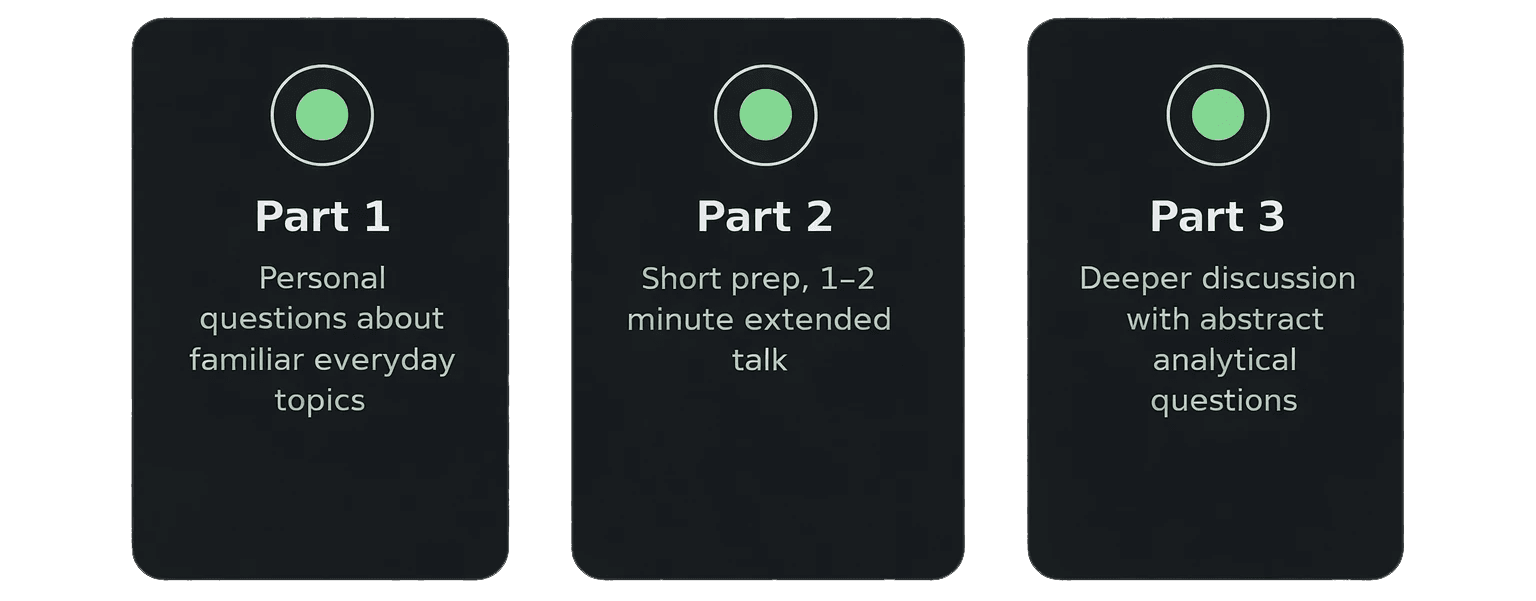
The speaking test consists of three parts, each designed to evaluate different aspects of communication.
Part 1: Personal Introduction
This section includes simple questions about familiar topics such as your hometown, hobbies, work, or family. Although seemingly easy, examiners use this segment to evaluate natural fluency and comfort with everyday topics.
Part 2: The Cue Card
You receive a prompt and have one minute to prepare before speaking for 1–2 minutes. This part assesses your ability to deliver structured, coherent extended speech.
Part 3: Analytical Discussion
This section expands on the previous topic, focusing on abstract or complex questions. It evaluates your ability to reason, speculate, compare, and justify opinions.
According to IELTS Official, the test aims to replicate real-life communication scenarios, not rehearsed monologues.
Modern Trends in IELTS Speaking Preparation
The evolution of digital learning has changed how candidates prepare for the IELTS speaking test. Several trends shape preparation methods in 2025:
AI-Enhanced Practice
AI tools provide instant feedback on fluency, coherence, and pronunciation. Tener.AI is part of this wave—offering simulations that replicate real examiner interactions.
Virtual Speaking Partners
Many learners now practice with international peers, often through platforms recommended by Forbes, to gain exposure to different accents and communication styles.
Pronunciation Analytics
Speech-recognition technology helps learners analyze stress patterns, pacing, and clarity—essential for high-band scores.
Scenario-Based Speaking Drills
Candidates train with complex themes (globalization, environment, culture, technology) to strengthen Part 3 performance.
How Students and Professionals Can Improve IELTS Speaking Performance
To excel in the speaking test, candidates need targeted strategies. One of the strongest methods is practicing long-form speaking without hesitation. The more you speak continuously, the more naturally cohesive your answers become.
Another strategy involves building thematic vocabulary. IELTS questions frequently explore global issues, workplace scenarios, and personal development topics. Familiarity with these themes allows for more precise, mature responses.
Third, recording practice sessions is essential. Reviewing recordings reveals pacing issues, unclear pronunciation, or repetitive vocabulary. With Tener.AI, learners receive structured breakdowns, pinpointing exactly where fluency breaks or where grammar inaccuracies occur.
Finally, interacting with native or proficient speakers is invaluable. Feedback from real conversations helps you adapt quickly—especially for unexpected follow-ups.
Common Mistakes in the IELTS Speaking Test
Many candidates struggle not because of poor English but because of poor delivery. Speaking too fast, overthinking vocabulary, or giving memorized answers can lower scores significantly.
Others avoid elaboration, giving short or incomplete responses. Since examiners evaluate coherence and development of ideas, brevity without explanation can be a disadvantage.
Another common pitfall is overuse of filler words, such as “um,” “like,” or “you know.” These reduce perceived fluency. Through structured practice environments provided by Tener.AI, learners can detect these verbal habits and reduce them before the test.
Lastly, candidates often misunderstand Part 3’s goal. It’s not about being right—it’s about reasoning, comparing, and justifying.
Common Mistake | Why It Happens | Effect on Score | How to Fix It |
Giving Short, Underdeveloped Answers | Nervousness or misunderstanding of the need to expand ideas. | Lowers fluency and coherence scores. | Practice structured responses with examples and explanations. |
Overusing Filler Words | Hesitation, lack of clarity, or thinking while speaking. | Makes speech sound less fluent and less confident. | Record practice sessions and reduce repetitions through feedback. |
Speaking Too Fast | Attempting to sound fluent or cover mistakes. | Decreases pronunciation clarity and coherence. | Control pacing and practice steady, intentional delivery. |
Memorized Answers | Relying on scripted responses instead of natural communication. | Examiners penalize unnatural, rehearsed speech. | Train with unpredictable prompts and real-time responses. |
Vocabulary Overcompensation | Using overly complex words that disrupt natural flow. | Weakens coherence and may lead to grammatical errors. | Focus on precision and clarity instead of showing off vocabulary. |
How to Choose the Best Preparation Method for the IELTS Speaking Test
Choosing the right preparation method requires aligning your goals, weaknesses, and learning style. Some learners benefit from one-on-one tutoring, while others need structured digital practice. When selecting online tools, ensure the platform offers personalized feedback, topic variety, and the ability to track improvement.
For global candidates, the ability to evaluate English fluency in real contexts is especially crucial. Tools like Tener.AI offer an advantage by combining task simulations with AI scoring that aligns closely with assessment categories used by official examiners.
Additionally, check for content authenticity and credibility. Trusted sources like BBC Learning English and EF Education First provide reliable practice materials and listening resources that reinforce speaking performance.
Summary Table
Aspect | Basic Preparation | Structured IELTS Speaking Prep | Advanced Prep with AI (Tener.AI) |
Fluency Practice | Irregular | Consistent | Real-time AI feedback |
Pronunciation Training | Limited | Guided exercises | Speech analytics |
Cue Card Performance | Unstructured | Topic-based practice | Personalized simulation |
Abstract Discussion Skills | Weak | Moderate | Advanced reasoning guidance |
Feedback Quality | Minimal | Human feedback | Detailed AI scoring |
Conclusion
The IELTS speaking test is a powerful indicator of real-world English communication skills. It measures more than grammar—it evaluates how confidently and coherently you express ideas in dynamic, unpredictable conversations. With global mobility increasing and hybrid communication becoming the norm, strong speaking skills are more important than ever.
By combining traditional practice methods with modern AI-driven tools like Tener.AI, learners can build fluency, accuracy, and confidence more effectively. Whether preparing for study, work, or immigration, mastering the IELTS speaking test in 2025 is an investment in long-term global opportunities.
FAQ
What is the IELTS speaking test?
It is a 11–14 minute oral exam that assesses fluency, coherence, vocabulary, grammar, and pronunciation through structured conversation with an examiner.
How is the IELTS speaking test scored?
Examiners score four criteria equally: fluency and coherence, lexical resource, grammatical range and accuracy, and pronunciation.
Is the speaking test difficult?
It can be challenging because it requires spontaneous, natural communication—not memorized responses.
How can I improve quickly?
Regular speaking practice, recording your responses, expanding vocabulary, and using AI tools like Tener.AI accelerate improvement.
Is the test the same for IELTS Academic and General Training?
Yes, the speaking component is identical for both versions.

" height="80.94400020599366px" id="qIjvZtSLI" transform="translate(0 12.275)" width="373.7409916992187px"/><path d="M 0 9.975 C 0 7.247 0.974 4.902 2.919 2.942 C 4.949 0.981 7.361 0 10.152 0 C 12.858 0 15.228 0.938 17.259 2.814 C 19.287 4.689 20.302 6.991 20.302 9.719 C 20.302 12.447 19.287 14.791 17.259 16.752 C 15.311 18.712 12.943 19.692 10.152 19.692 C 8.799 19.692 7.488 19.437 6.219 18.926 C 5.054 18.427 3.982 17.735 3.046 16.88 C 2.101 16.007 1.326 14.966 0.761 13.81 C 0.251 12.596 -0.008 11.292 0 9.975 Z" fill="rgb(34, 191, 89)" height="19.691999999999993px" id="yONhdWkLI" transform="translate(289.772 72.503)" width="20.30220185337174px"/><path d="M 15.225 0.001 L 0 0.001 L 0 61.38 L 15.225 61.38 L 15.225 0 Z" fill="rgb(245, 245, 245)" height="61.38px" id="D4KrqKylr" transform="translate(387.929 30.049)" width="15.225000000000023px"/><path d="M 0 9.207 C 0 6.735 0.888 4.603 2.664 2.813 C 4.526 0.938 6.852 0 9.643 0 C 12.435 0 14.761 0.895 16.622 2.685 C 18.567 4.39 19.541 6.565 19.541 9.207 C 19.541 11.85 18.567 14.066 16.622 15.857 C 14.761 17.561 12.435 18.414 9.643 18.414 C 6.852 18.414 4.526 17.518 2.664 15.728 C 0.888 13.853 0 11.679 0 9.207 Z" fill="rgb(245, 245, 245)" height="18.414px" id="Qi52r923l" transform="translate(385.771 0)" width="19.54099999999994px"/></g></svg>)