Interview Questions
Emotional Intelligence Interview Questions: How Companies Identify Self-Awareness, Empathy, and Leadership Potential
Dec 26, 2025

Introduction
Emotional intelligence has become one of the defining competencies in modern hiring. Technical skills remain essential, but organizations increasingly recognize that long-term performance is shaped by how people manage emotions, communicate under pressure, and build trust with others. For this reason, emotional intelligence interview questions are now a core element of recruitment strategies across industries.
Unlike traditional competency questions, emotional intelligence interview questions focus on how candidates perceive themselves, interpret others’ emotions, and respond to emotionally complex situations. These questions help employers understand whether an applicant can manage conflict constructively, demonstrate empathy, and regulate their reactions when circumstances become challenging.
Research from Harvard Business Review highlights that emotionally intelligent employees are more likely to collaborate effectively, remain resilient during stress, and contribute positively to workplace culture. In distributed and multicultural teams, emotional intelligence is no longer optional; it is a foundational skill for maintaining productivity and morale.
AI-supported platforms such as Tener AI complement emotional intelligence assessment by analyzing how candidates articulate emotionally nuanced experiences, adding structure and consistency to evaluation processes.
What Are Emotional Intelligence Interview Questions?
Emotional intelligence interview questions are behavioral prompts designed to uncover how candidates perceive emotions, handle interpersonal challenges, and regulate their own reactions. These questions do not test technical expertise but instead focus on awareness, empathy, adaptability, and relationship management.
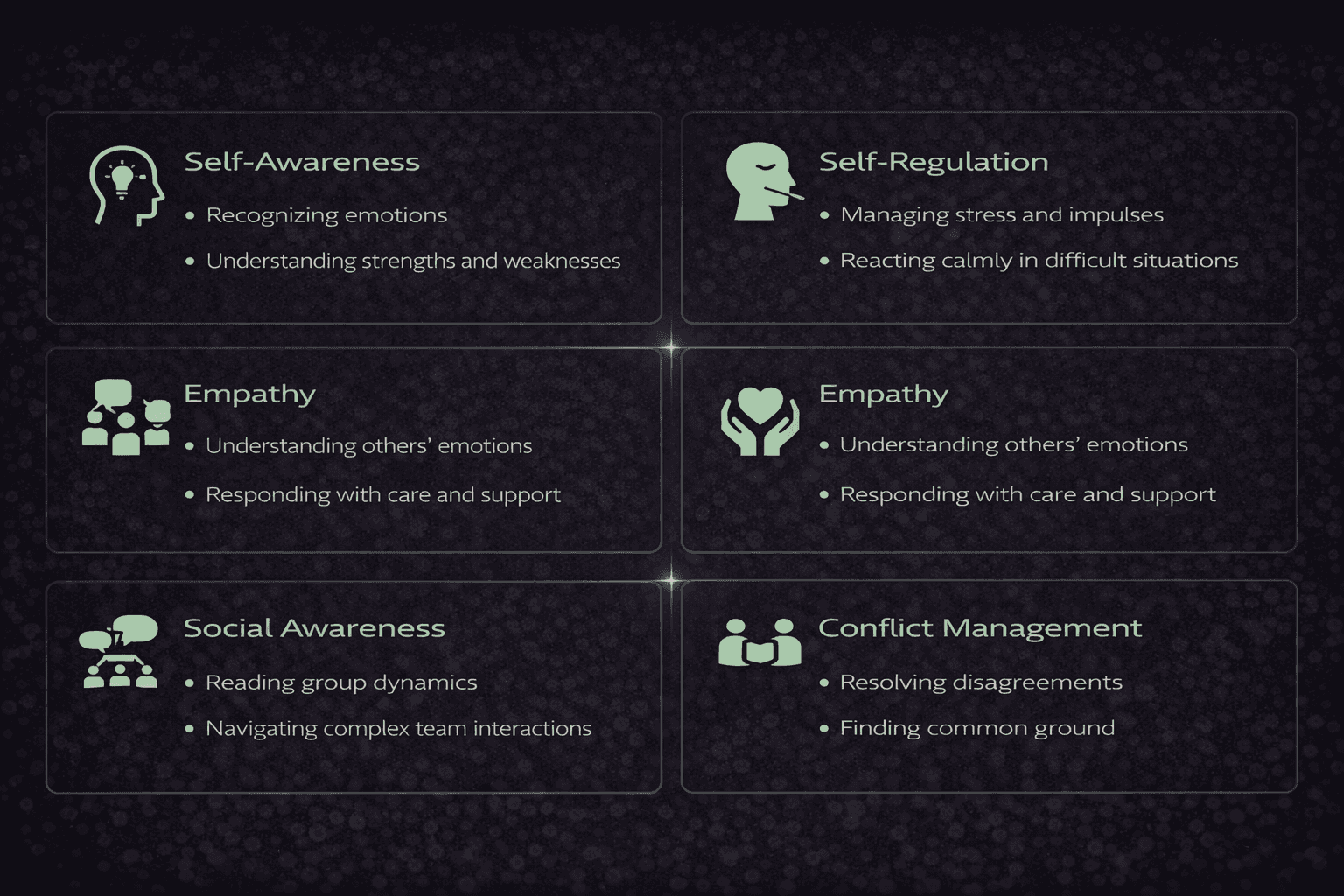
Candidates are asked to describe past situations involving disagreement, feedback, failure, or teamwork under stress. Their responses reveal how they interpreted others’ emotions, how they managed their own reactions, and whether they took responsibility for outcomes. According to guidance from SHRM, emotional intelligence competencies are among the strongest predictors of leadership readiness and long-term engagement.
Unlike situational questions, emotional intelligence prompts require introspection. They uncover whether candidates demonstrate genuine reflection or rely on surface-level explanations. Over time, organizations have found that emotionally intelligent professionals tend to become informal leaders, stabilizing teams during periods of change.
Why Emotional Intelligence Interview Questions Matter
Emotional intelligence interview questions matter because workplace success depends on more than logic and execution. Every role involves interpersonal interaction, whether with clients, colleagues, or stakeholders. Candidates who cannot regulate emotions or empathize with others often struggle in collaborative environments, regardless of technical ability.
These questions reveal how candidates respond to stress, disappointment, criticism, or disagreement. As noted by LinkedIn Talent Solutions, professionals with strong emotional intelligence are more adaptable, communicate more clearly, and demonstrate higher retention rates.
Emotional intelligence also protects organizations from internal friction. Employees who lack empathy may unintentionally damage relationships, reduce morale, and escalate conflict. Behavioral answers that demonstrate awareness, humility, and growth mindset signal that a candidate can navigate complex emotional dynamics productively.
AI tools such as Tener AI further enhance this evaluation by highlighting clarity, tone consistency, and emotional structure within candidate responses, enabling hiring teams to make more informed judgments.
Why Emotional Intelligence Interview Questions Matter
Reason | What Is Revealed | Recruiter Insight | Hiring Impact |
|---|---|---|---|
Emotional regulation | How candidates manage stress | Identifies resilience under pressure | Reduces burnout risk |
Empathy | Ability to understand others | Shows interpersonal maturity | Improves teamwork |
Conflict management | Handling of disagreement | Predicts collaboration style | Strengthens culture |
Self-awareness | Reflection on mistakes | Indicates learning mindset | Enhances leadership potential |
Core Benefits of Using Emotional Intelligence Interview Questions
One of the most valuable outcomes of emotional intelligence interview questions is their ability to surface patterns of emotional behavior that cannot be detected through technical assessments alone. These questions expose how candidates experience workplace stress, how they react when expectations are not met, and how they internalize feedback. Rather than measuring performance in isolation, they reveal how individuals interact within the emotional ecosystem of an organization.
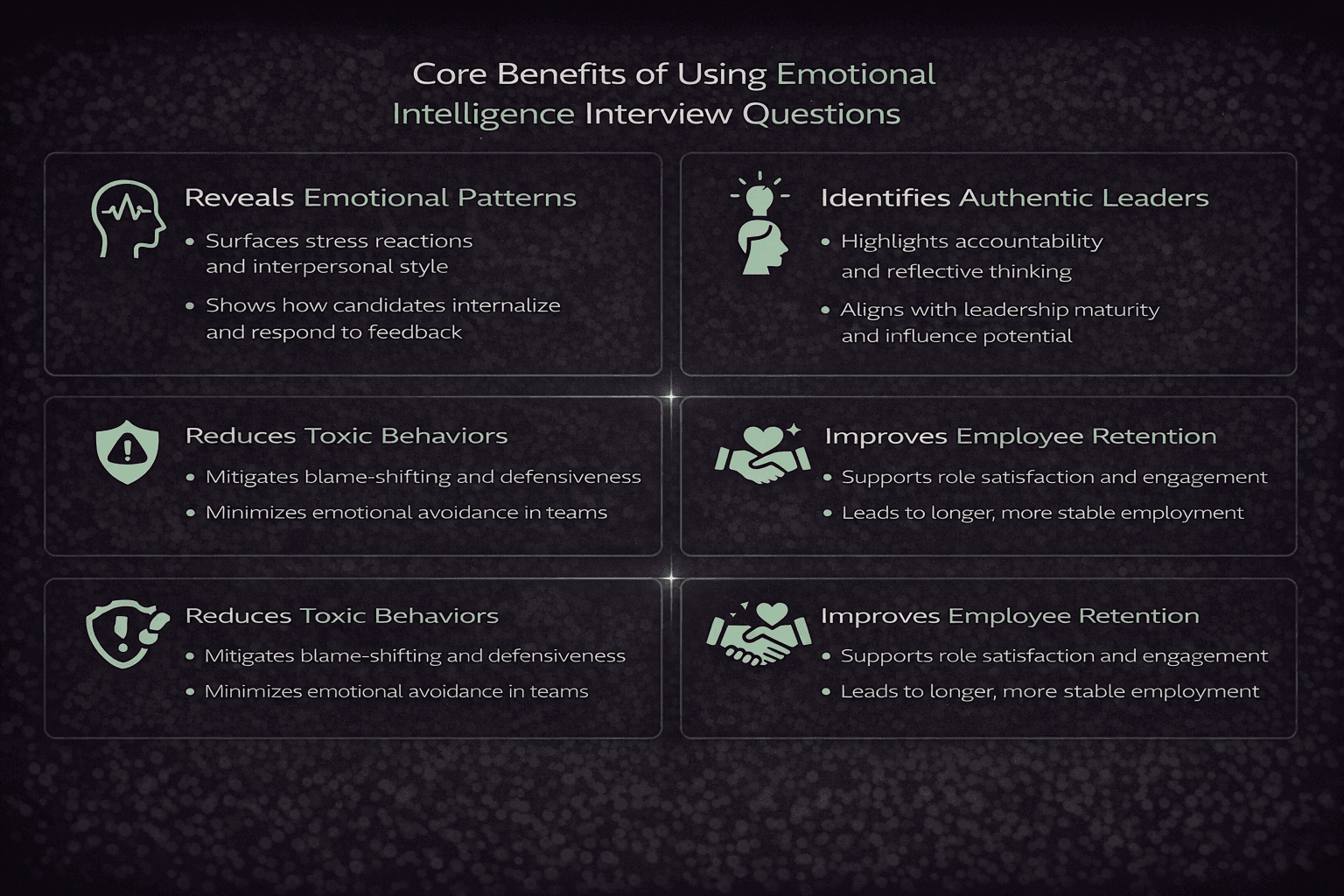
Another important benefit is the identification of authentic leadership potential. Candidates who demonstrate emotional awareness, accountability, and reflective thinking often show early signs of leadership maturity. They are more likely to motivate others, navigate difficult conversations, and create psychologically safe environments. Research from Harvard Business Review confirms that emotionally intelligent leaders build more resilient teams and sustain higher engagement over time.
Emotional intelligence questions also reduce the risk of toxic behavior entering the organization. While many candidates perform well on technical tests, these questions uncover tendencies toward blame-shifting, defensiveness, or emotional avoidance. Detecting these traits early protects team dynamics and prevents costly performance issues later.
Another core benefit is stronger long-term retention. Employees who understand their emotional triggers and manage relationships effectively are more satisfied with their roles and less likely to disengage or leave prematurely. As highlighted by SHRM, emotional intelligence is a key factor in employee engagement and retention across all industries.
Finally, emotional intelligence interview questions contribute to cultural stability. They help employers hire individuals who align with the organization’s emotional norms—whether those norms emphasize transparency, psychological safety, adaptability, or collaborative accountability. When paired with AI-supported language analysis through tools like Tener AI, recruiters gain deeper insight into how candidates articulate emotional experiences and whether their communication style supports healthy workplace relationships.
Real-World Examples Across Industries
In technology companies, emotional intelligence interview questions often reveal how candidates manage failure in fast-paced environments. Engineers, product managers, and data scientists routinely face pressure, conflicting priorities, and rapidly changing requirements. Their behavioral responses illustrate whether they become defensive under scrutiny or use feedback constructively to iterate and improve. Teams that hire emotionally intelligent technologists experience fewer internal breakdowns during high-stress release cycles.
In healthcare, emotional intelligence is inseparable from job performance. Nurses, physicians, and administrative staff must respond calmly to emotionally intense situations involving patients and families. Emotional intelligence questions uncover how candidates regulate stress, express empathy, and maintain professionalism in moments of vulnerability. According to Harvard Medical School, emotional competence directly influences patient satisfaction and safety outcomes.
In finance and consulting, professionals operate in environments where mistakes can have major financial implications. Emotional intelligence interview questions reveal how candidates manage pressure, communicate risk, and maintain ethical judgment during uncertainty. Firms that prioritize emotional intelligence report stronger client relationships and higher internal trust.
In education, teachers and academic leaders rely heavily on emotional awareness to engage diverse learners, resolve classroom conflict, and adapt instruction. Candidates who demonstrate reflective emotional intelligence are better equipped to create inclusive, supportive learning environments.
In remote and distributed organizations, emotional intelligence becomes even more critical. Without face-to-face interaction, misunderstandings can escalate quickly. Behavioral responses show whether candidates communicate proactively, clarify emotional context, and maintain connection across distance. Tools like Tener AI help global companies evaluate whether candidates can express emotional nuance clearly in English, which is essential for remote collaboration.
Across all industries, emotional intelligence interview questions translate abstract interpersonal skills into observable workplace behavior, allowing companies to hire professionals who strengthen not only performance, but also organizational resilience.
Types of Emotional Intelligence Interview Questions
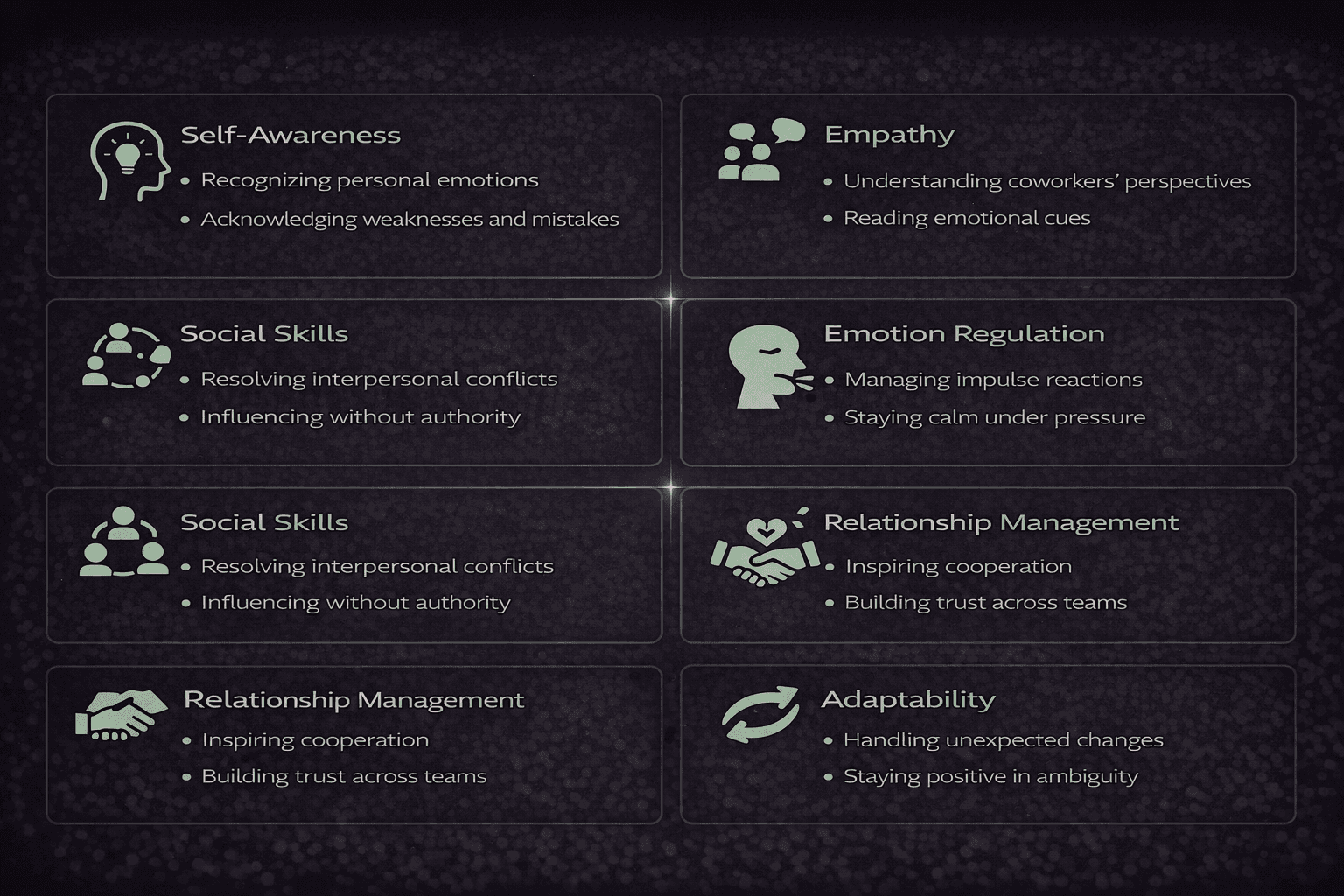
Emotional intelligence interview questions can be grouped into several conceptual types, each designed to reveal a different dimension of how candidates perceive and manage emotions. One of the most important categories focuses on self-awareness. These questions invite candidates to reflect on personal limitations, moments of failure, or instances when their behavior negatively affected others. The depth of reflection, honesty, and willingness to acknowledge imperfection signal how well an individual understands their own emotional patterns.
Another category explores empathy and perspective-taking. Candidates are asked to describe situations where they had to understand the emotions or motivations of colleagues, clients, or stakeholders. These responses uncover whether individuals recognize emotional cues in others or default to task-centric reasoning. Empathetic answers often reveal a genuine interest in relationship quality rather than mere conflict resolution.
A third type examines emotional regulation. These questions investigate how candidates respond when faced with frustration, criticism, or high-pressure deadlines. Recruiters observe whether candidates describe impulsive reactions or deliberate emotional control. Professionals who explain how they paused, reframed the situation, or sought constructive dialogue demonstrate emotional maturity.
Some emotional intelligence questions focus on social influence and leadership without authority. These prompts explore how candidates motivate peers, mediate disagreements, or gain trust across hierarchical boundaries. Their answers reveal subtle leadership capabilities rooted in emotional awareness rather than formal power.
Finally, adaptability-based questions assess how individuals manage emotionally disruptive change. These include responses to restructuring, role ambiguity, or unexpected feedback. Strong answers demonstrate emotional flexibility, learning orientation, and resilience, which are critical traits in modern workplaces.
How to Analyze Emotional Intelligence Answers
Analyzing emotional intelligence interview answers requires attention not only to what is said but also to how it is communicated. Recruiters begin by assessing narrative depth. Candidates with strong emotional intelligence provide detailed context, explain their emotional state, describe the emotions of others, and reflect on the consequences of their actions. Superficial answers that skip emotional content often signal limited awareness.
Another key indicator is accountability. Emotionally intelligent professionals take responsibility for their reactions rather than deflecting blame. They articulate what they could have done better and how the experience influenced their behavior in future situations.
Interviewers also evaluate emotional vocabulary. Candidates who can name emotions accurately demonstrate advanced self-awareness. Their language reflects internal processing rather than generic statements such as “everything was fine” or “it was difficult.”
Tone and coherence play an equally important role. Well-structured, calm narratives suggest regulated emotional processing, while fragmented or overly defensive responses may indicate unresolved emotional patterns. Tools like Tener AI assist recruiters by analyzing clarity, coherence, and consistency in candidate language, providing objective insight into emotional expression.
Finally, recruiters look for learning orientation. Strong emotional intelligence answers conclude with reflection—how the candidate changed, what they learned, and how they apply those insights today. This growth mindset is often the clearest indicator that emotional intelligence is not just a trait, but an actively developed skill.
Trends and Innovations in Emotional Intelligence Assessment
The assessment of emotional intelligence is rapidly evolving as organizations recognize that interpersonal competence cannot be measured through traditional interviews alone. One of the most significant trends is the adoption of AI-supported language analysis. These tools identify subtle emotional cues in candidate narratives, such as hesitation patterns, emotional vocabulary range, and coherence of reflection. According to insights published by Forbes, AI-driven communication analysis is becoming a core element in leadership and talent assessments.
Another emerging trend is asynchronous emotional intelligence interviewing. Instead of evaluating candidates in live conversations only, organizations now collect recorded responses to emotionally complex prompts. This allows recruiters to observe how candidates process emotional situations without real-time pressure, producing more authentic insights into emotional reasoning.
Psychometric modeling is also gaining traction. Modern recruitment platforms correlate emotional intelligence indicators with employee performance data, helping companies understand which emotional traits predict success in specific roles. Over time, this feedback loop allows organizations to refine their interview frameworks based on real outcomes rather than assumptions.
Additionally, emotional intelligence assessment is increasingly integrated into employer branding strategies. Candidates are drawn to organizations that value empathy, well-being, and psychological safety. Highlighting emotional intelligence during interviews signals that the company prioritizes healthy workplace relationships rather than transactional performance alone.
Finally, hybrid hiring environments have influenced how emotional intelligence is evaluated. Virtual interactions demand heightened emotional clarity, active listening, and precise expression. Platforms like Tener AI support this transition by analyzing spoken English clarity and emotional structure, ensuring that communication competence is assessed objectively across global candidate pools.
Trends in Emotional Intelligence Interviewing
Trend | What It Enables | Recruiter Benefit | Hiring Outcome |
|---|---|---|---|
AI-supported analysis | Emotional tone detection | Deeper candidate insight | Higher accuracy |
Asynchronous interviews | Flexible responses | Reduced scheduling barriers | Larger talent pool |
Behavioral analytics | Pattern recognition | Evidence-based decisions | Lower hiring risk |
Leadership EQ mapping | Leadership potential assessment | Succession planning | Stronger pipelines |
How Businesses Can Integrate Emotional Intelligence Interview Questions
Integrating emotional intelligence interview questions into hiring practices requires deliberate alignment between role expectations, company culture, and evaluation methodology. Organizations begin by identifying which emotional competencies drive success in each function. For leadership roles, this may include emotional regulation and influence; for customer-facing positions, empathy and conflict management may be more critical.
Interviewers must be trained to probe beneath surface narratives. Rather than accepting generic success stories, they should encourage candidates to unpack emotional complexity by asking how situations felt, how reactions were managed, and how relationships were affected. This depth of inquiry transforms emotional intelligence from a vague concept into a measurable competency.
Companies also benefit from embedding emotional intelligence assessment across multiple interview stages. Early screening may focus on communication clarity and emotional self-awareness, while later stages explore leadership behaviors and adaptability. This layered approach improves reliability and prevents over-reliance on a single interaction.
Technology plays an important role in integration. AI-supported tools such as Tener AI provide structured analysis of language clarity, emotional coherence, and reflection depth, enabling recruiters to identify patterns that may otherwise go unnoticed.
Finally, businesses must ensure alignment between emotional intelligence evaluation and internal culture. When organizations consistently hire emotionally intelligent professionals, they reinforce values such as transparency, accountability, and collaboration, creating a self-sustaining ecosystem of emotionally healthy teams.
Summary Table
Section | Focus | Key Insight | Business Value |
|---|---|---|---|
Definition | Emotional behavior | Reveals real interpersonal skills | Better team fit |
Importance | Workplace dynamics | Predicts resilience | Higher retention |
Benefits | Leadership readiness | Supports growth mindset | Stronger culture |
Industry Examples | Applied EQ | Contextual relevance | Role alignment |
Trends | AI-assisted analysis | Objective insight | Improved hiring accuracy |
Conclusion
Emotional intelligence interview questions uncover the human capabilities that determine long-term success. They provide insight into empathy, self-awareness, and emotional regulation—qualities that shape leadership, collaboration, and resilience. By combining structured interviewing with AI-supported analysis tools such as Tener AI, organizations gain a powerful framework for hiring emotionally intelligent professionals who elevate team performance.
FAQ
What are emotional intelligence interview questions?
They are behavioral questions designed to assess how candidates perceive, manage, and respond to emotions.
Why is emotional intelligence important in hiring?
Because it predicts collaboration quality, leadership readiness, and long-term engagement.
How do recruiters evaluate emotional intelligence?
Through reflection depth, emotional vocabulary, accountability, and growth mindset.
Can AI assess emotional intelligence?
Yes. AI tools analyze clarity, tone consistency, and emotional structure in responses.
Which roles require high emotional intelligence?
Leadership, customer-facing, healthcare, education, and cross-functional roles benefit most.

" height="80.94400020599366px" id="qIjvZtSLI" transform="translate(0 12.275)" width="373.7409916992187px"/><path d="M 0 9.975 C 0 7.247 0.974 4.902 2.919 2.942 C 4.949 0.981 7.361 0 10.152 0 C 12.858 0 15.228 0.938 17.259 2.814 C 19.287 4.689 20.302 6.991 20.302 9.719 C 20.302 12.447 19.287 14.791 17.259 16.752 C 15.311 18.712 12.943 19.692 10.152 19.692 C 8.799 19.692 7.488 19.437 6.219 18.926 C 5.054 18.427 3.982 17.735 3.046 16.88 C 2.101 16.007 1.326 14.966 0.761 13.81 C 0.251 12.596 -0.008 11.292 0 9.975 Z" fill="rgb(34, 191, 89)" height="19.691999999999993px" id="yONhdWkLI" transform="translate(289.772 72.503)" width="20.30220185337174px"/><path d="M 15.225 0.001 L 0 0.001 L 0 61.38 L 15.225 61.38 L 15.225 0 Z" fill="rgb(245, 245, 245)" height="61.38px" id="D4KrqKylr" transform="translate(387.929 30.049)" width="15.225000000000023px"/><path d="M 0 9.207 C 0 6.735 0.888 4.603 2.664 2.813 C 4.526 0.938 6.852 0 9.643 0 C 12.435 0 14.761 0.895 16.622 2.685 C 18.567 4.39 19.541 6.565 19.541 9.207 C 19.541 11.85 18.567 14.066 16.622 15.857 C 14.761 17.561 12.435 18.414 9.643 18.414 C 6.852 18.414 4.526 17.518 2.664 15.728 C 0.888 13.853 0 11.679 0 9.207 Z" fill="rgb(245, 245, 245)" height="18.414px" id="Qi52r923l" transform="translate(385.771 0)" width="19.54099999999994px"/></g></svg>)