Interview Questions
Behavioral Interview Questions: How Employers Predict Performance Through Past Behavior
Dec 23, 2025

Introduction
Behavioral interview questions have become one of the most widely used tools in modern hiring. Unlike traditional interview questions that focus on hypothetical situations or abstract strengths, behavioral questions are grounded in a simple but powerful idea: past behavior is one of the strongest predictors of future performance.
Employers across industries use behavioral interview questions to understand how candidates think, act, communicate, and make decisions in real workplace situations. These questions reveal how individuals handle pressure, collaborate with others, resolve conflict, manage time, and adapt to change. According to research published by Harvard Business Review, structured behavioral interviews consistently outperform unstructured interviews in predicting job success.
As hiring becomes more data-driven and competitive, companies rely on behavioral interviewing to reduce bias, improve consistency, and identify candidates who align with both role requirements and company culture. When combined with AI-supported analysis tools such as Tener AI, behavioral interviews offer even deeper insight into communication clarity, reasoning patterns, and decision-making quality.
This article explains what behavioral interview questions are, why they matter, how they are evaluated, and how organizations use them to make better hiring decisions.
What Are Behavioral Interview Questions?
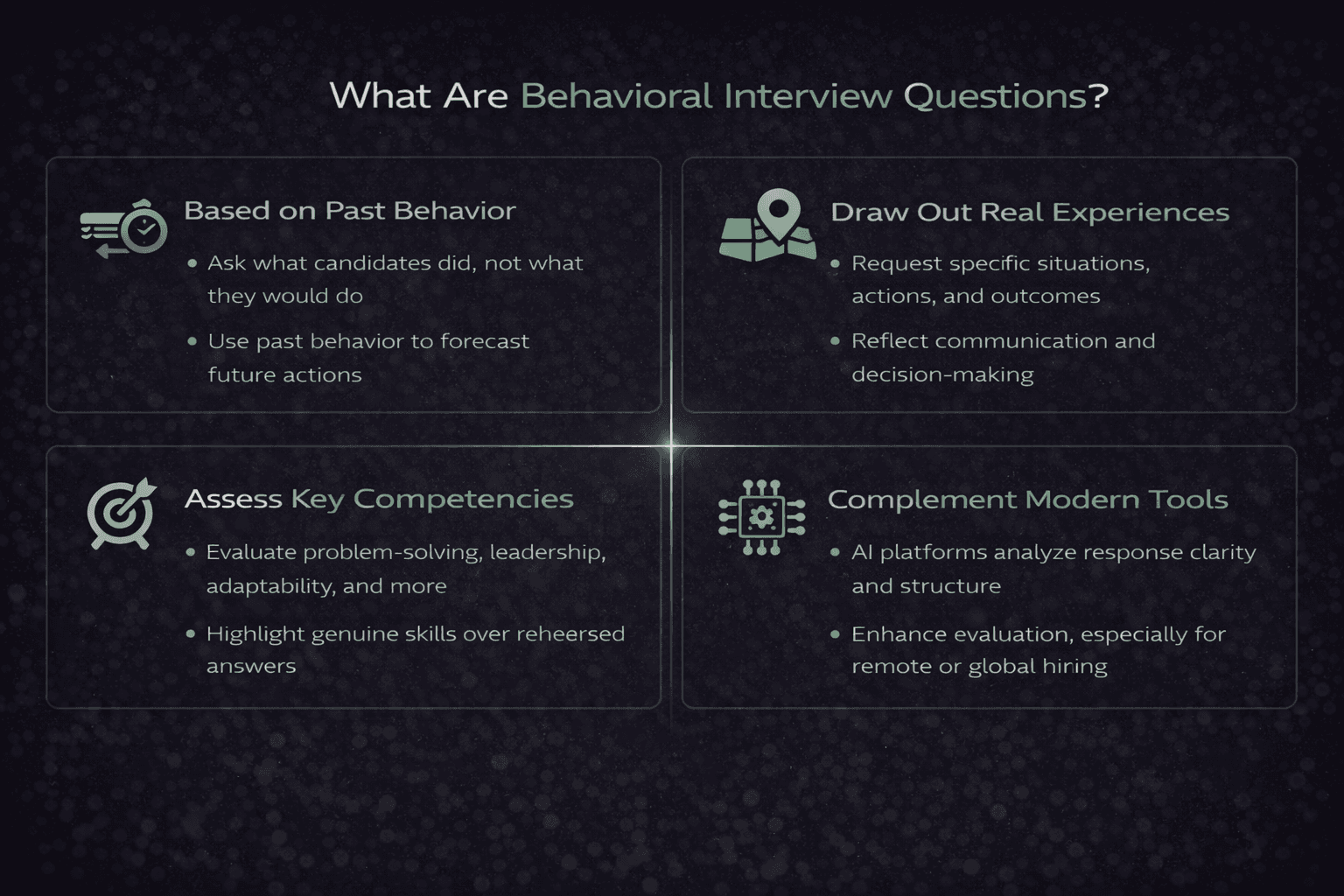
Behavioral interview questions are designed to elicit specific examples from a candidate’s past experiences. Rather than asking what a candidate would do, these questions ask what the candidate has done in real situations. The assumption behind this approach is that behavior patterns tend to repeat when individuals face similar circumstances.
These questions typically prompt candidates to describe a situation, explain their role, outline the actions they took, and reflect on the outcome. This structure allows interviewers to assess not only results but also thought processes, communication style, accountability, and interpersonal behavior. As explained by Indeed, behavioral questions focus on observable actions rather than self-perception or intention.
Behavioral interview questions are used to evaluate a wide range of competencies, including problem-solving, teamwork, leadership, conflict resolution, adaptability, and time management. They are particularly valuable because they reduce the effectiveness of rehearsed or generic answers. Candidates must rely on authentic experiences, making it easier for interviewers to distinguish genuine competence from surface-level confidence.
Modern hiring teams increasingly complement behavioral interviews with AI-driven tools. Platforms like Tener AI analyze how candidates structure their responses, how clearly they communicate, and how consistently they reason through scenarios. This layered evaluation strengthens the reliability of behavioral interviewing, especially in global or remote hiring contexts.
Why Behavioral Interview Questions Matter
Behavioral interview questions matter because they bring objectivity and structure into the hiring process. Traditional interviews often rely heavily on intuition, which can be influenced by bias, first impressions, or conversational chemistry. Behavioral questions, by contrast, anchor evaluation in evidence drawn from real experience.
One reason these questions are so effective is that they expose decision-making under pressure. Candidates describe moments when things did not go smoothly—tight deadlines, interpersonal conflict, limited resources, or unexpected change. Their responses reveal resilience, emotional intelligence, and judgment. According to SHRM, candidates who demonstrate reflective thinking and accountability in behavioral interviews are more likely to succeed in complex roles.
Behavioral questions also help assess cultural alignment. Every organization has implicit norms around communication, ownership, feedback, and collaboration. When candidates explain how they behaved in past environments, interviewers can evaluate whether those behaviors align with internal values.
Another reason behavioral questions matter is consistency. When interviewers use the same behavioral framework across candidates, comparisons become more reliable. This structured approach reduces randomness in hiring decisions and improves fairness.
In remote and hybrid workplaces, behavioral interviewing is especially important. Employers need to know whether candidates can work autonomously, communicate proactively, and adapt without constant supervision. Behavioral answers reveal these traits far more clearly than resumes alone. With AI-supported platforms like Tener AI, recruiters can further analyze communication clarity and response structure, strengthening confidence in hiring decisions.
Why They Matter | What Is Revealed | Recruiter Insight | Hiring Impact |
|---|---|---|---|
Evidence-based evaluation | Real actions in past situations | Reduces reliance on intuition | Improves hiring accuracy |
Decision-making under pressure | Judgment and emotional control | Predicts performance in complex roles | Reduces early turnover |
Cultural alignment | Communication and collaboration style | Shows values compatibility | Strengthens team cohesion |
Consistency and fairness | Comparable candidate data | Supports structured evaluation | Improves diversity and objectivity |
Core Benefits of Using Behavioral Interview Questions
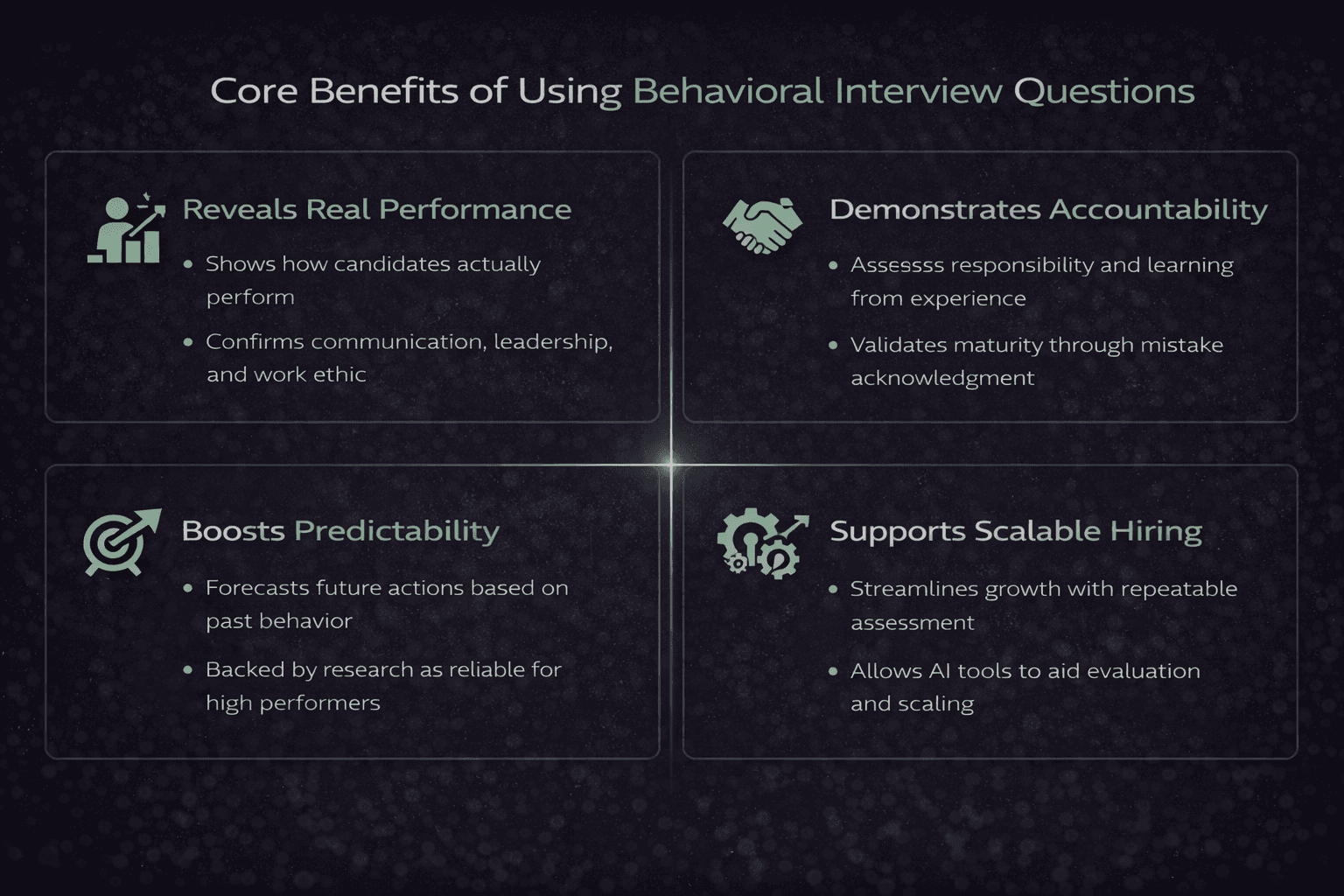
One of the primary benefits of behavioral interview questions is their ability to uncover how candidates actually perform rather than how they describe themselves. Candidates may claim to be strong communicators or effective leaders, but behavioral answers reveal whether those claims are supported by real experiences.
Another benefit is the insight into accountability. Behavioral questions show whether candidates take responsibility for outcomes, acknowledge mistakes, and learn from experience. Candidates who consistently attribute success to teamwork and reflect thoughtfully on challenges tend to demonstrate higher professional maturity.
Behavioral interviewing also improves predictability. Because these questions focus on repeatable behavior patterns, they offer stronger signals about future performance than abstract discussions of skills. Research cited by McKinsey & Company indicates that structured behavioral interviews significantly increase the likelihood of selecting high performers.
These questions also enhance interviewer confidence. When decisions are supported by concrete examples and structured criteria, hiring teams can justify their choices more clearly to stakeholders.
Finally, behavioral interview questions support scalable hiring. When organizations grow quickly, they need repeatable, reliable assessment methods. Behavioral frameworks, combined with AI-assisted analysis through tools like Tener AI, allow companies to maintain quality while scaling recruitment.
Real-World Examples Across Industries
In technology companies, behavioral interview questions often focus on problem-solving, collaboration, and adaptability. Candidates may describe how they resolved production incidents, navigated disagreements with product teams, or adjusted priorities during fast-changing projects. These answers reveal how well individuals function in high-pressure, iterative environments.
In healthcare, behavioral questions assess communication, empathy, and adherence to protocols. Candidates describe situations involving patient care coordination, ethical dilemmas, or teamwork during emergencies. Research from Harvard Business Review shows that strong behavioral competencies correlate with improved patient outcomes.
In customer service and retail, behavioral interviews explore how candidates handle difficult customers, manage emotional situations, and maintain professionalism. Employers look for evidence of emotional regulation, problem-solving, and service mindset.
In education, candidates discuss classroom management, curriculum adaptation, and collaboration with colleagues. Behavioral responses reveal teaching philosophy, adaptability, and communication style.
In remote-first organizations, behavioral questions focus heavily on autonomy, communication, and time management. Candidates describe how they structured work independently, coordinated across time zones, and maintained accountability. These examples help employers assess readiness for distributed work environments.
Across industries, behavioral interview questions translate abstract competencies into concrete, job-relevant evidence.
Types of Behavioral Interview Questions
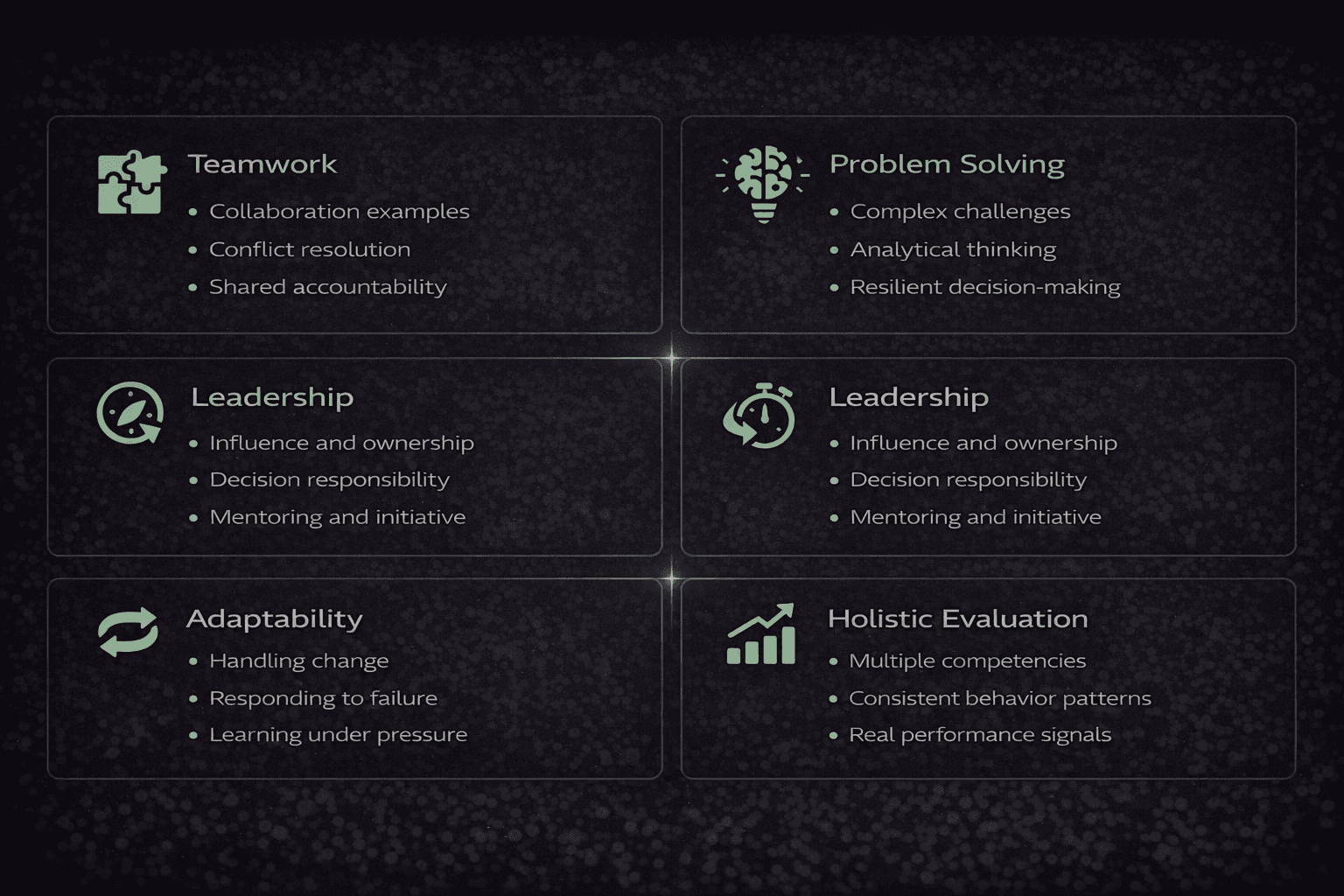
Behavioral interview questions can be grouped by the competencies they assess. Some focus on teamwork, asking candidates to describe collaborative experiences, conflict resolution, or shared accountability. These questions highlight interpersonal skills and communication style.
Other questions assess problem-solving. Candidates explain how they approached complex challenges, analyzed information, and implemented solutions. These responses reveal analytical thinking and resilience.
Leadership-focused behavioral questions explore influence, decision-making, and responsibility. Candidates may describe mentoring others, leading initiatives, or navigating difficult decisions.
Adaptability questions examine how candidates respond to change, failure, or ambiguity. Strong answers demonstrate flexibility and learning orientation.
Time management and prioritization questions reveal how candidates organize work, manage deadlines, and balance competing demands. These questions are especially important for high-volume or remote roles.
By combining multiple types of behavioral questions, interviewers build a comprehensive picture of candidate capability.
How to Analyze Behavioral Interview Answers Effectively
Analyzing behavioral answers requires attention to both content and delivery. Interviewers listen for specificity. Strong answers include concrete details, clear context, and logical progression. Vague or generalized responses often indicate limited experience or rehearsed narratives.
Accountability is another key signal. Effective candidates acknowledge their role in outcomes rather than deflecting responsibility. They demonstrate self-awareness and learning from experience.
Interviewers also evaluate communication clarity. Well-structured responses indicate organized thinking. Rambling or disjointed answers may suggest difficulty prioritizing information.
Tone and emotional language provide additional insight. Candidates who speak respectfully about colleagues and challenges tend to demonstrate emotional intelligence.
AI-powered tools like Tener AI enhance this analysis by evaluating linguistic clarity, coherence, and response structure, providing objective signals that complement human judgment.
Trends and Innovations in Behavioral Interviewing
Behavioral interviewing continues to evolve with technology. One major trend is AI-supported interview analysis. According to Forbes, AI tools help identify communication patterns, reasoning quality, and consistency across interviews.
Another innovation is structured competency mapping. Organizations align behavioral questions with defined role competencies, improving precision.
Virtual and asynchronous behavioral interviews are also becoming common. Candidates respond to prompts on their own schedule, allowing employers to evaluate communication style without scheduling constraints.
Behavioral analytics integrated into ATS platforms allow recruiters to compare responses across candidates and roles, improving consistency.
These innovations strengthen behavioral interviewing as a scalable, data-driven hiring method.
Trend | What It Enables | Recruiter Benefit | Hiring Outcome |
|---|---|---|---|
AI-assisted analysis | Objective response evaluation | Deeper insight into communication | Higher prediction accuracy |
Competency-based frameworks | Role-aligned questioning | Clear evaluation criteria | Better role fit |
Asynchronous interviews | Flexible candidate responses | Reduced scheduling friction | Expanded talent pool |
Behavioral analytics | Cross-candidate comparison | Consistent decision-making | Fairer hiring outcomes |
How Businesses Can Integrate Behavioral Interview Questions
Organizations integrate behavioral interview questions most effectively when they align them with job-specific competencies. This requires identifying the behaviors that drive success in each role and designing questions accordingly.
Training interviewers is critical. Hiring teams must learn how to probe for detail, ask follow-up questions, and evaluate responses consistently.
Combining behavioral interviews with other assessment methods—such as skills tests or AI-driven communication analysis—creates a balanced evaluation system. Tener AI supports this integration by adding objective insight into how candidates articulate experiences and reason through scenarios.
When implemented thoughtfully, behavioral interviewing becomes a cornerstone of reliable, scalable hiring.
Section | Main Focus | Key Insight | Business Value |
|---|---|---|---|
Definition | Past behavior assessment | Predicts future performance | Stronger hiring decisions |
Importance | Structured evaluation | Reduces bias | Improved fairness |
Core Benefits | Evidence-based insight | Reveals real competence | Higher quality hires |
Industry Use | Role-specific behavior | Contextual relevance | Better performance fit |
Analysis | Response evaluation | Clarity and accountability | Reduced hiring risk |
Conclusion
Behavioral interview questions provide one of the most reliable ways to understand how candidates will perform in real workplace situations. By focusing on past behavior, employers gain insight into judgment, communication, accountability, and cultural alignment. When combined with structured frameworks and AI-supported analysis tools like Tener AI, behavioral interviewing becomes a powerful, scalable approach to hiring with confidence.
FAQ
What are behavioral interview questions?
They are questions that ask candidates to describe real past experiences to predict future performance.
Why do employers use behavioral interviews?
Because past behavior is a strong indicator of future job success.
How should candidates answer behavioral questions?
By giving specific examples, explaining actions taken, and reflecting on outcomes.
Are behavioral interviews better than traditional interviews?
Research shows they are more predictive and consistent.
Can AI support behavioral interviewing?
Yes. AI tools like Tener AI analyze clarity, structure, and reasoning in candidate responses.

" height="80.94400020599366px" id="qIjvZtSLI" transform="translate(0 12.275)" width="373.7409916992187px"/><path d="M 0 9.975 C 0 7.247 0.974 4.902 2.919 2.942 C 4.949 0.981 7.361 0 10.152 0 C 12.858 0 15.228 0.938 17.259 2.814 C 19.287 4.689 20.302 6.991 20.302 9.719 C 20.302 12.447 19.287 14.791 17.259 16.752 C 15.311 18.712 12.943 19.692 10.152 19.692 C 8.799 19.692 7.488 19.437 6.219 18.926 C 5.054 18.427 3.982 17.735 3.046 16.88 C 2.101 16.007 1.326 14.966 0.761 13.81 C 0.251 12.596 -0.008 11.292 0 9.975 Z" fill="rgb(34, 191, 89)" height="19.691999999999993px" id="yONhdWkLI" transform="translate(289.772 72.503)" width="20.30220185337174px"/><path d="M 15.225 0.001 L 0 0.001 L 0 61.38 L 15.225 61.38 L 15.225 0 Z" fill="rgb(245, 245, 245)" height="61.38px" id="D4KrqKylr" transform="translate(387.929 30.049)" width="15.225000000000023px"/><path d="M 0 9.207 C 0 6.735 0.888 4.603 2.664 2.813 C 4.526 0.938 6.852 0 9.643 0 C 12.435 0 14.761 0.895 16.622 2.685 C 18.567 4.39 19.541 6.565 19.541 9.207 C 19.541 11.85 18.567 14.066 16.622 15.857 C 14.761 17.561 12.435 18.414 9.643 18.414 C 6.852 18.414 4.526 17.518 2.664 15.728 C 0.888 13.853 0 11.679 0 9.207 Z" fill="rgb(245, 245, 245)" height="18.414px" id="Qi52r923l" transform="translate(385.771 0)" width="19.54099999999994px"/></g></svg>)