Interview
Conflict Resolution Interview Questions: Evaluating Communication, Emotional Intelligence, and Workplace Maturity
Dec 16, 2025

Introduction
Conflict is a natural component of professional environments. Whether it arises from competing priorities, personality differences, unclear responsibilities, or external pressures, conflict shapes how teams operate and how effectively individuals work together. This is why many companies use conflict resolution interview questions to understand how candidates respond to disagreement, tension, and emotionally charged situations.
These interview questions reveal who remains calm under pressure, who communicates with empathy, and who can turn disagreements into constructive outcomes. A candidate’s ability to handle conflict reflects not only their interpersonal maturity but also their readiness to work in fast-paced, collaborative environments. Research from Harvard Business Review highlights that effective conflict management is directly correlated with higher team productivity, trust, and organizational resilience.
In today’s multinational and hybrid workplaces, conflict takes new forms—miscommunications in digital channels, cultural misunderstandings, role ambiguity, and remote-team friction. As a result, conflict resolution interview questions have become one of the most reliable tools for understanding a candidate’s emotional intelligence, communication habits, and professional behavior. Platforms like Tener.AI help employers analyze the clarity and tone of candidates' answers, offering deeper insights into how well they can navigate sensitive or challenging conversations in English.
What Are Conflict Resolution Interview Questions?
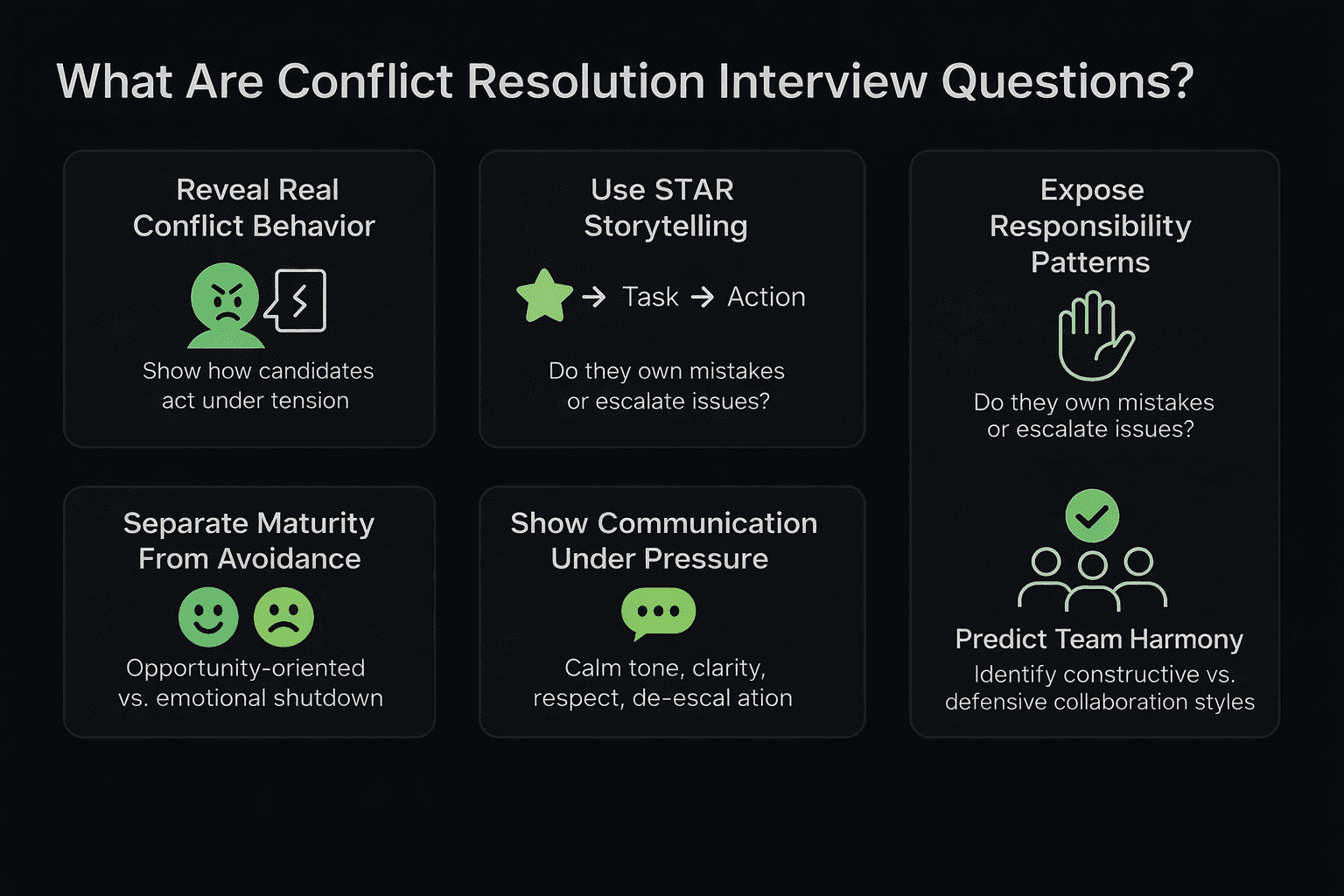
Conflict resolution interview questions are behavioral and situational questions designed to uncover how candidates approach disagreements, misunderstandings, or friction with colleagues, clients, or stakeholders. These questions push candidates to describe real-life situations and the actions they took to address them. They reveal far more than technical expertise—they demonstrate how a candidate acts when emotions are heightened, when communication is strained, or when stakes are high.
Organizations such as Indeed highlight that conflict-focused questions often rely on structured storytelling frameworks, such as STAR (Situation, Task, Action, Result), to encourage clear descriptions of past experiences. Through these stories, hiring teams identify patterns: Does the candidate take responsibility? Do they communicate respectfully? Do they escalate issues appropriately or let them intensify? Are they proactive about preventing conflict in the first place?
These questions also reveal whether the candidate sees conflict as a threat or an opportunity. Mature professionals understand that disagreements can lead to innovation and improved alignment. Immature candidates may avoid confrontation, shut down communication, or respond emotionally. The way candidates describe conflict says a great deal about their professionalism, emotional discipline, and collaboration style.
Conflict resolution interview questions help employers evaluate how well a candidate can maintain composure, structure communication, and navigate complex interpersonal dynamics. They expose whether a candidate acts defensively or constructively, whether they listen more than they react, and whether they seek solutions rather than victories. As teams become more cross-functional and globally distributed, these insights are invaluable in predicting workplace harmony and performance.
Why Conflict Resolution Interview Questions Matter
The importance of conflict management continues to grow as businesses rely more heavily on teamwork, digital collaboration, and rapid decision-making. Misunderstandings happen easily, especially in remote or multilingual environments. When not addressed, small disagreements become barriers to efficiency, trust, and innovation. Because of this, conflict resolution interview questions have become central to evaluating soft skills during the hiring process.
One reason they matter is that conflict often reveals behaviors that remain hidden in ordinary work conditions. As LinkedIn Talent Solutions reports, conflict interactions surface communication patterns, emotional responses, and decision-making tendencies that offer deep insights into how a person handles stress. These questions help hiring teams predict how candidates will behave during real workplace challenges—not just during polished interview moments.
Another reason is that conflict often intersects with responsibilities and expectations. When priorities shift or resources tighten, conflict becomes inevitable. Candidates who can communicate transparently, negotiate fairly, and maintain professionalism contribute to organizational stability. Those who respond impulsively or defensively often create friction that slows progress or weakens team morale.
Conflict questions matter because they highlight accountability. Candidates who take responsibility for misunderstandings or process failures demonstrate maturity and ownership. Candidates who blame others, avoid responsibility, or fail to reflect on their actions often struggle in collaborative environments.
Finally, these questions reveal cultural compatibility. Some organizations value direct, honest conversations; others prioritize diplomacy and harmony. Through conflict stories, employers can determine whether candidates align with their communication culture. When combined with AI-driven analysis tools like Tener.AI, companies gain an even clearer picture of how well candidates express themselves and navigate tension in English.
Reason They Matter | What Recruiters Learn | Impact on Team Dynamics | Value for Hiring Accuracy |
Revealing real behavioral patterns | Shows how candidates respond under interpersonal stress. | Predicts stability and trust within teams. | Improves selection of emotionally mature professionals. |
Assessing communication maturity | Demonstrates tone, clarity, empathy, and listening ability. | Enhances collaboration and reduces misunderstandings. | Helps identify strong communicators for hybrid teams. |
Evaluating accountability | Shows whether candidates accept responsibility or deflect blame. | Strengthens team reliability and alignment. | Reduces long-term performance risks. |
Understanding cultural fit | Reveals preferred conflict style and interpersonal values. | Prevents tension caused by mismatched expectations. | Supports long-term retention and cohesion. |
Core Benefits of Using Conflict Resolution Interview Questions
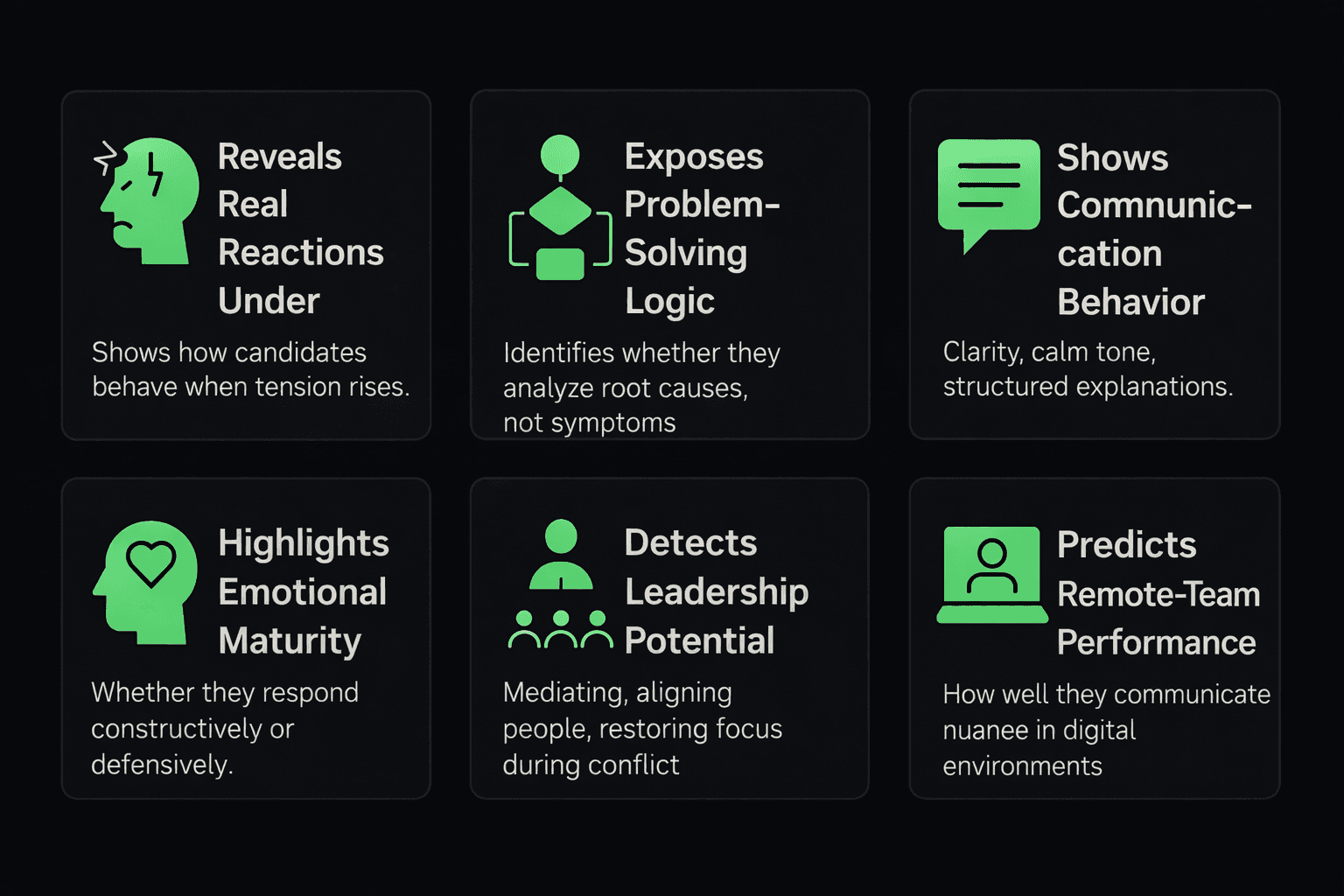
One of the strongest benefits of conflict resolution interview questions is their ability to uncover how candidates behave when things do not go as planned. Anyone can perform well when tasks are smooth, but only emotionally mature professionals manage tension, miscommunication, and conflicting priorities with composure and respect. These questions help identify whether a candidate reacts defensively, avoids conflict altogether, or approaches disagreement with openness and strategic thinking.
Another benefit is the insight into problem-solving logic. Conflict often disguises deeper issues—unclear expectations, lack of resources, role confusion, or competing incentives. Candidates who can recognize these patterns demonstrate analytical thinking, not just emotional restraint. Recruiters observe whether the candidate jumps to conclusions or takes time to understand the broader context before responding.
These questions also highlight communication behaviors. As SHRM indicates, communication failures are one of the most common causes of workplace conflict. Candidates who communicate calmly, structure their explanations clearly, and keep discussions respectful during conflict tend to perform better in collaborative roles.
Conflict-based questions reveal leadership potential as well. Individuals who mediate disputes, align teams, or help colleagues regain focus during disagreements demonstrate natural leadership qualities even before they reach managerial positions.
Finally, conflict resolution interview questions help organizations evaluate how candidates may behave in remote environments—where tone, clarity, and emotional nuance can be harder to interpret. Tener.AI can analyze the linguistic structure of candidate responses, helping identify communication patterns that affect global collaboration.
Real-World Examples Across Industries
Conflict occurs in every industry, though it manifests in distinct ways. In technology, conflict commonly appears when engineering, design, and product teams debate priorities. Disagreements over user experience, deadlines, or scope creep require professionals who can communicate calmly and help teams align. Recruiters evaluating tech candidates often look for examples of negotiating trade-offs or unifying differing viewpoints.
In healthcare, conflict emerges during high-pressure scenarios where physicians, nurses, and administrative staff must coordinate patient care. Miscommunication can affect safety, so conflict resolution demands clarity, emotional composure, and rapid decision-making. Findings from Harvard Business Review show that medical teams with effective conflict strategies achieve significantly better patient outcomes.
In customer service, conflict often involves emotional customers. Employees must balance service quality with internal processes, sometimes negotiating between customer expectations and company policies. Candidates with strong conflict skills demonstrate empathy while staying aligned with organizational standards.
In hospitality and retail, conflict might arise between staff during peak periods. High stress amplifies misunderstandings, so teamwork and calm communication are essential. Recruiters look for examples of managing customer disputes, redistributing workload, or maintaining professionalism under pressure.
In hybrid and remote teams across all sectors, conflict often stems from unclear digital communication or cultural differences. Insights from LinkedIn Talent Solutions show that employees who articulate conflict clearly in virtual environments are more resilient and more productive.
Across all industries, conflict resolution interview questions reveal whether candidates escalate problems or neutralize them, whether they create clarity or confusion, and whether they build unity or divide teams. These insights guide hiring teams toward people who strengthen the organizational culture rather than destabilizing it.
Types of Conflict Resolution Interview Questions
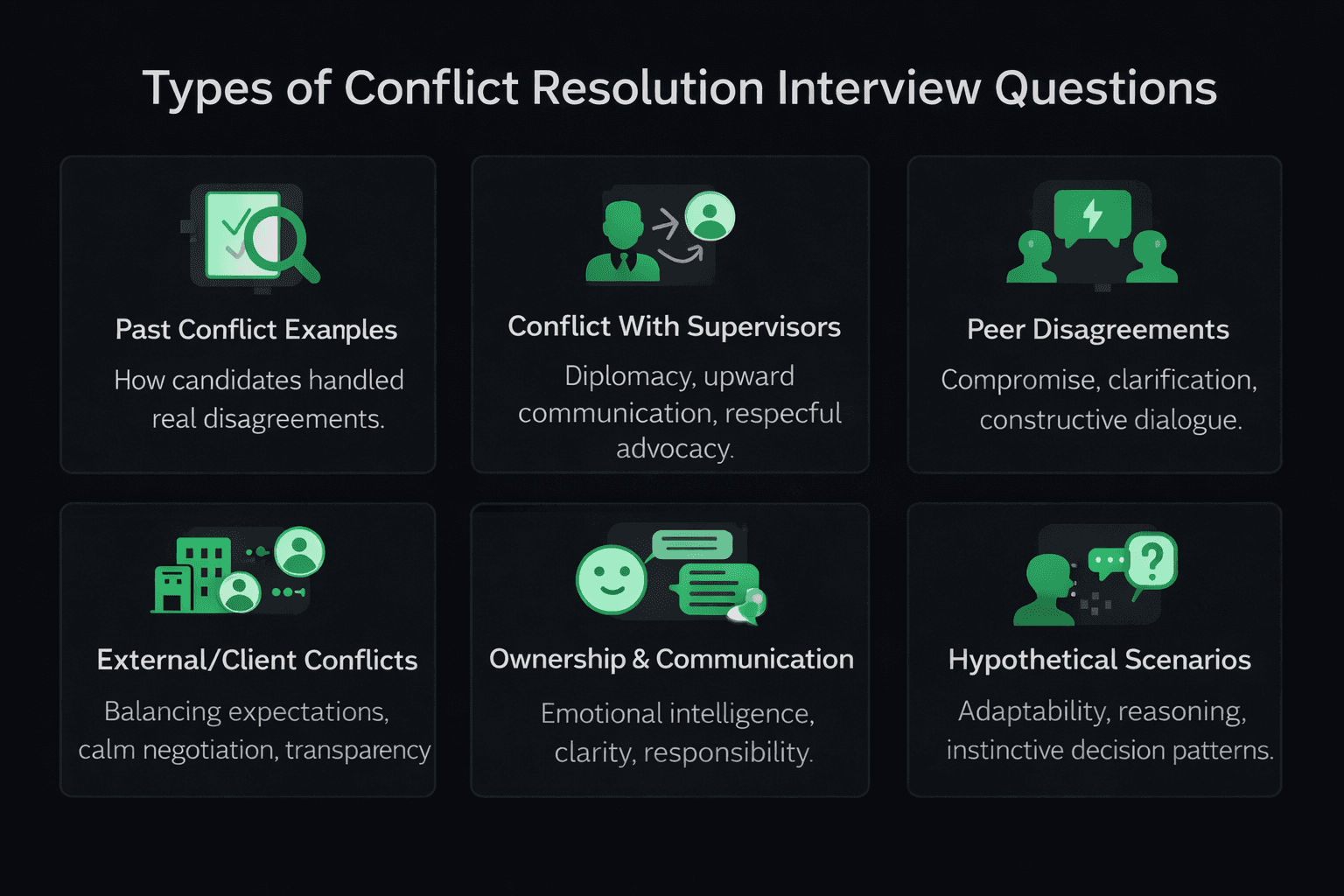
Conflict questions typically explore several dimensions of professional behavior. Recruiters often start with questions about past disagreements, asking candidates to describe how they approached tense moments and what steps they took toward resolution. These stories help identify emotional intelligence, communication style, and ownership mentality.
Another type involves conflict with supervisors or authority figures. Candidates must explain how they navigated disagreements respectfully while advocating for their perspective. Responses reveal whether candidates communicate upward with diplomacy or whether they struggle under hierarchical pressure.
Some questions focus on peer friction—such as misunderstandings, duplicated efforts, or opposing opinions about priorities. These scenarios show whether the candidate is willing to compromise, ask clarifying questions, or initiate constructive dialogue.
Other questions explore conflicts caused by clients, stakeholders, or external partners. These situations require balancing organizational interests with external expectations. Strong candidates demonstrate calm negotiation and transparent communication.
Finally, hypothetical or situational questions test how candidates would react in unfamiliar scenarios. They measure adaptability, reasoning, and instinctive decision patterns—helping interviewers assess how candidates might behave when facing new forms of conflict.
How to Analyze Conflict Resolution Answers Effectively
Analyzing conflict answers requires paying close attention to emotional tone, language choice, and reasoning. Recruiters look for candidates who maintain professionalism even when describing emotionally charged situations. A balanced tone indicates emotional control; overly harsh or excessively defensive descriptions suggest unresolved tension or immaturity.
Interviewers also listen for clarity and structure. Strong candidates explain events logically, acknowledge their role, describe the actions they took, and reflect on lessons learned. This demonstrates reflective thinking and accountability.
Evaluating how candidates talk about others is equally important. Professionals who maintain respect toward colleagues—even when describing conflict—are more likely to strengthen team culture. Those who blame or criticize may carry negativity into future roles.
Finally, platforms like Tener.AI assist in analyzing linguistic clarity and communication patterns, helping employers determine whether candidates can navigate conflict respectfully in English.
Trends and Innovations in Conflict Resolution Skill Evaluation
Modern conflict evaluation increasingly uses AI-assisted tools, behavioral analytics, and practical simulations. Insights from Forbes emphasize that AI can detect tone control, cognitive load, and communication clarity, giving hiring teams deeper insight than traditional interviews alone.
Scenario-based assessments simulate real workplace conflicts, such as resource constraints or conflicting deadlines. Companies influenced by McKinsey & Company adopt these simulations to evaluate how candidates react under pressure.
Digital communication assessments—particularly for remote roles—test how candidates resolve conflict through chat, email, and online calls. This dimension has become essential as virtual misunderstandings grow more prevalent.
Behavioral analytics within ATS systems help track patterns across candidate answers, revealing consistency or lack of it. Paired with platforms like Tener.AI, hiring teams can combine human judgment with data-driven clarity insights.
Innovation | What It Measures | Recruiter Insight | Hiring Impact |
AI-Assisted Interview Analysis | Emotional tone, communication patterns, clarity. | Identifies maturity and conflict-handling instincts. | Reduces bias and strengthens evaluation consistency. |
Scenario-Based Assessments | Behavior during realistic conflict situations. | Reveals problem-solving logic and emotional stability. | Improves prediction of workplace performance. |
Digital Communication Evaluation | Conflict handling in virtual environments. | Shows readiness for hybrid and global teams. | Reduces miscommunication risks. |
Behavioral Analytics | Patterns in conflict narratives. | Highlights consistency and accountability. | Supports data-backed hiring decisions. |
How Businesses Can Integrate Conflict Resolution Evaluation
Effective integration requires a structured, multi-layered approach. Teams must identify the types of conflicts common in their environment—client-facing tension, cross-department misalignment, leadership disagreements, or remote communication friction. Only then can hiring teams design interview questions that reflect real organizational conditions.
Pairing behavioral questions with situational assessments creates a full picture of a candidate’s conflict style. Observing how candidates reflect on past conflict reveals their maturity; observing how they respond in new conflict scenarios shows their instincts.
Businesses should also train interviewers to ask deeper follow-up questions, as superficial stories rarely reveal true behaviors. Insights from Harvard Business Review show that probing questions generate higher accuracy than generic behavioral questions alone.
Hybrid and global teams must also evaluate written communication during conflict. Tener.AI can analyze written or spoken answers to ensure the candidate can communicate respectfully and clearly in English.
When integrated thoughtfully, conflict evaluation strengthens hiring accuracy and reduces long-term organizational risk.
Summary Table — Entire Article
Section | Purpose | Recruiter Insight | Impact on Hiring Quality |
Definition | Explains what conflict questions evaluate. | Reveals behavior under interpersonal pressure. | Sets foundation for candidate comparison. |
Importance | Shows why conflict management is essential. | Highlights communication and emotional intelligence. | Improves cultural and role fit. |
Core Benefits | Illustrates soft skills uncovered through conflict questions. | Identifies leadership potential and accountability. | Enhances predictive accuracy. |
Industry Examples | Shows conflict across sectors. | Provides contextual understanding. | Aligns expectations with real work. |
Types of Questions | Breaks down evaluation dimensions. | Shows communication, empathy, reasoning. | Supports balanced evaluation. |
Analysis Techniques | Explains how to interpret answers. | Highlights tone, structure, maturity. | Reduces hiring risk. |
Trends & Innovations | Presents modern AI and simulation tools. | Identifies deeper behavioral cues. | Improves accuracy with data insights. |
Business Integration | Shows how to operationalize conflict evaluation. | Aligns assessment with team needs. | Strengthens long-term hiring outcomes. |
Conclusion
Conflict is an inevitable part of work, but how professionals respond to it defines their success and the success of the teams around them. Conflict resolution interview questions reveal communication habits, emotional intelligence, self-awareness, and problem-solving behavior—traits that shape the health of the workplace. By combining behavioral questions, situational assessments, and AI-powered clarity evaluation through tools like Tener.AI, organizations gain a multidimensional understanding of how candidates navigate tension and disagreement.
Strong conflict management leads to trust, productivity, and organizational stability. Hiring people who can resolve conflict constructively is one of the most effective ways to build resilient, collaborative teams.
FAQ
What are conflict resolution interview questions?
They are behavioral questions designed to evaluate how candidates handle disagreements, miscommunication, or tension in professional settings.
Why do employers ask conflict resolution questions?
Because conflict reveals communication skills, emotional intelligence, accountability, and maturity—core predictors of collaboration success.
What do strong conflict answers look like?
They show clarity, respect, accountability, and a solution-oriented mindset.
How can I prepare for conflict questions?
Reflect on past team challenges, focus on your role, emphasize communication, and describe what you learned.
Why is conflict resolution important in remote teams?
Remote communication amplifies misunderstandings, so clarity, tone, and empathy matter more than ever.

" height="80.94400020599366px" id="qIjvZtSLI" transform="translate(0 12.275)" width="373.7409916992187px"/><path d="M 0 9.975 C 0 7.247 0.974 4.902 2.919 2.942 C 4.949 0.981 7.361 0 10.152 0 C 12.858 0 15.228 0.938 17.259 2.814 C 19.287 4.689 20.302 6.991 20.302 9.719 C 20.302 12.447 19.287 14.791 17.259 16.752 C 15.311 18.712 12.943 19.692 10.152 19.692 C 8.799 19.692 7.488 19.437 6.219 18.926 C 5.054 18.427 3.982 17.735 3.046 16.88 C 2.101 16.007 1.326 14.966 0.761 13.81 C 0.251 12.596 -0.008 11.292 0 9.975 Z" fill="rgb(34, 191, 89)" height="19.691999999999993px" id="yONhdWkLI" transform="translate(289.772 72.503)" width="20.30220185337174px"/><path d="M 15.225 0.001 L 0 0.001 L 0 61.38 L 15.225 61.38 L 15.225 0 Z" fill="rgb(245, 245, 245)" height="61.38px" id="D4KrqKylr" transform="translate(387.929 30.049)" width="15.225000000000023px"/><path d="M 0 9.207 C 0 6.735 0.888 4.603 2.664 2.813 C 4.526 0.938 6.852 0 9.643 0 C 12.435 0 14.761 0.895 16.622 2.685 C 18.567 4.39 19.541 6.565 19.541 9.207 C 19.541 11.85 18.567 14.066 16.622 15.857 C 14.761 17.561 12.435 18.414 9.643 18.414 C 6.852 18.414 4.526 17.518 2.664 15.728 C 0.888 13.853 0 11.679 0 9.207 Z" fill="rgb(245, 245, 245)" height="18.414px" id="Qi52r923l" transform="translate(385.771 0)" width="19.54099999999994px"/></g></svg>)