Adaptability Examples
Adaptability Examples: How Employers Identify Candidates Who Thrive in Change
Jan 9, 2026

Introduction
Adaptability has become one of the most valuable professional traits in modern workplaces. Technology evolves quickly, business priorities shift without warning, and global teams must constantly adjust to new processes, tools, and expectations. In this environment, organizations are no longer searching only for expertise—they are searching for people who can learn, recalibrate, and perform when circumstances change.
Adaptability examples provide tangible evidence of how individuals respond to uncertainty. Rather than focusing on static skills, these examples reveal learning agility, emotional resilience, and the ability to reframe challenges into opportunities. According to Harvard Business Review, adaptable employees are more likely to succeed in roles with evolving scope and ambiguous objectives.
This article explores what adaptability examples are, why they matter, how they are evaluated across industries, and how candidates and recruiters alike can use them to make better hiring decisions.
What Are Adaptability Examples?
Adaptability examples are concrete narratives that demonstrate how a person responded to change rather than simply endured it. They describe moments when established routines no longer worked, when assumptions had to be questioned, or when new expectations forced a shift in thinking or behavior. What makes these examples powerful is not the scale of the change, but the quality of the response. A well-articulated adaptability example shows awareness of the disruption, ownership of the adjustment process, and reflection on the outcome.
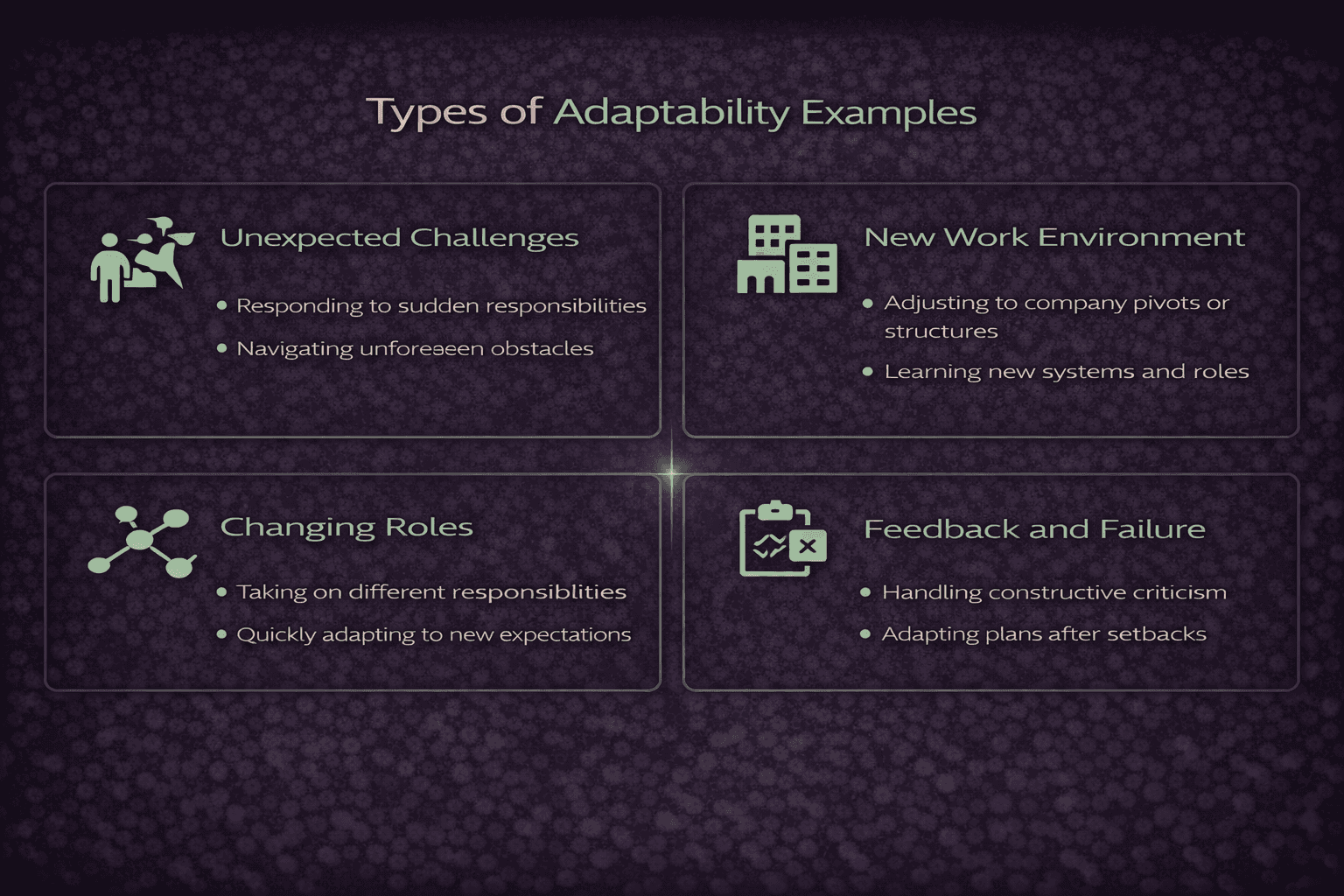
These stories often include subtle but revealing details. Candidates may describe how they recognized that their original approach was ineffective, how they sought input from others, or how they experimented with alternative strategies. This sequence of awareness, action, and reflection reveals learning agility, which is the cornerstone of adaptability. It allows recruiters to assess whether candidates treat change as an external inconvenience or as a trigger for growth.
Adaptability examples also capture emotional intelligence in motion. They show how individuals managed uncertainty, frustration, or even failure. The way a candidate talks about discomfort—whether they minimize it, externalize blame, or acknowledge it honestly—provides insight into resilience and mindset. In roles where ambiguity is the norm rather than the exception, these emotional and cognitive dimensions are often more predictive of success than technical skill alone.
Why Adaptability Examples Matter
Adaptability examples matter because the modern workplace is built around volatility. Business models evolve, technologies emerge unexpectedly, and global teams operate across cultural and operational boundaries. In such environments, it is no longer enough for employees to perform well when conditions are stable. They must demonstrate the ability to recalibrate when those conditions change.
From a hiring perspective, adaptability examples offer one of the clearest signals of future performance. They allow recruiters to move beyond surface-level claims of flexibility and evaluate whether a candidate has successfully navigated disruption in the past. As noted in research highlighted by McKinsey & Company, learning agility and the capacity to adapt are consistently linked with leadership readiness and sustained performance over time.
These examples also help organizations mitigate risk. Employees who struggle with change often disengage, resist new processes, or burn out. By contrast, candidates who describe proactive adaptation strategies signal that they are likely to remain productive during restructuring, technology migrations, or strategic pivots.
Finally, adaptability examples shape cultural alignment. Companies that prioritize experimentation, continuous improvement, or remote collaboration need people who do not wait for perfect conditions. When candidates articulate how they turned uncertainty into progress, they demonstrate that they can contribute to a culture where change is not a threat, but a constant source of momentum.
Reason | What It Reveals | Recruiter Insight | Hiring Impact |
|---|---|---|---|
Rapid change | Learning agility | Ability to reskill quickly | Stronger long-term performance |
Uncertainty | Emotional resilience | Handles ambiguity | Lower burnout risk |
Process shifts | Behavioral flexibility | Adjusts work style | Better team fit |
New technologies | Growth mindset | Adapts to innovation | Sustained relevance |
Core Benefits of Using Adaptability Examples
Adaptability examples provide hiring teams with insight into how candidates behave when reality diverges from expectations. While resumes outline what a person has accomplished, adaptability examples explain how those accomplishments were sustained when circumstances changed. This distinction is critical in modern organizations, where success depends on continuous adjustment rather than static expertise.
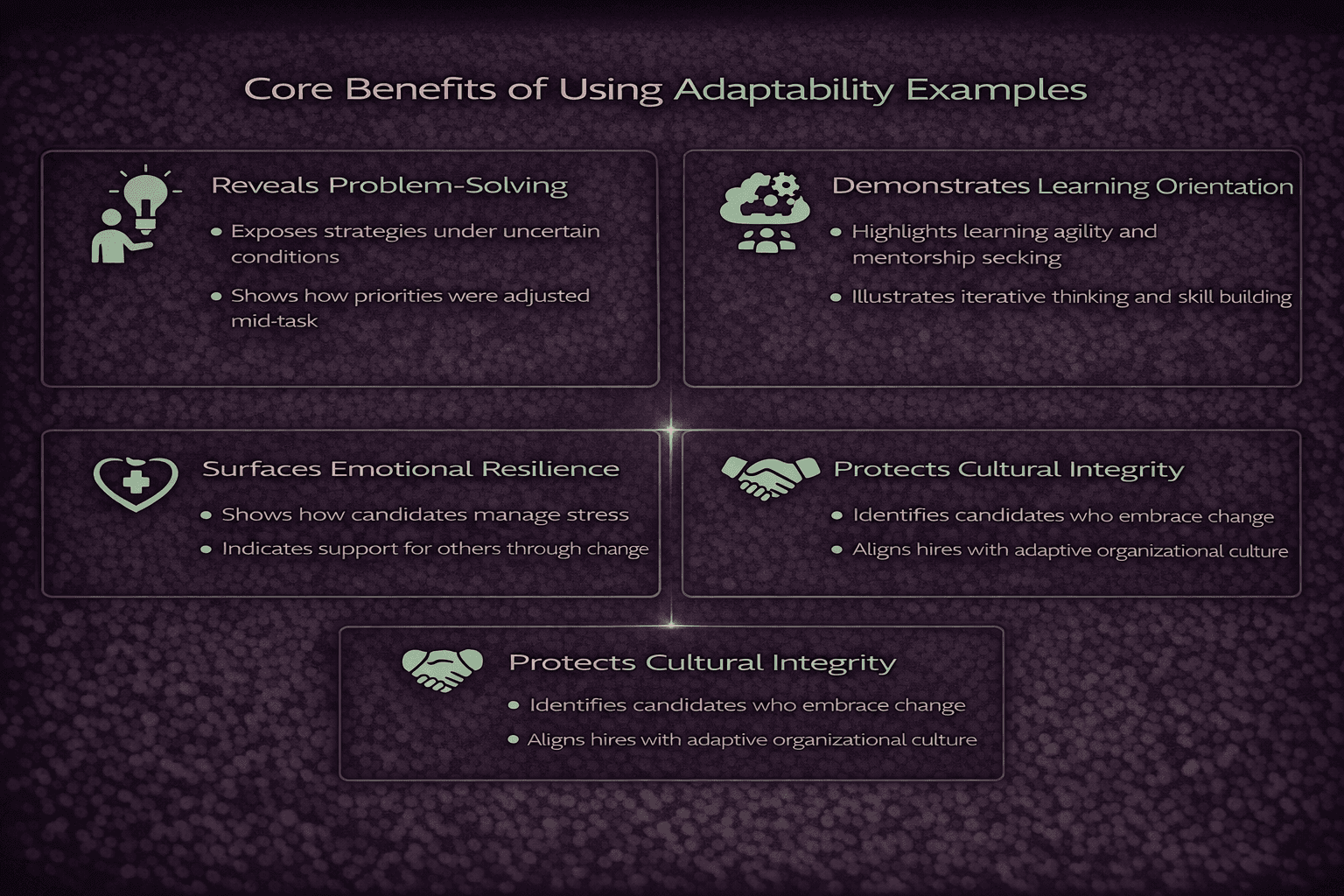
One of the core benefits of using adaptability examples is that they expose problem-solving under uncertainty. Candidates often describe moments when information was incomplete, priorities shifted unexpectedly, or tools failed. Their responses reveal whether they responded reactively or strategically. Recruiters learn how candidates re-evaluated assumptions, recalibrated goals, and maintained momentum despite disruption.
Another benefit lies in identifying learning orientation. Adaptable professionals rarely describe change as a one-time adjustment; instead, they emphasize how they learned new skills, sought mentorship, or iterated through multiple solutions. This learning mindset is one of the strongest predictors of long-term value in fast-moving environments.
Adaptability examples also surface emotional resilience. They show whether candidates internalized stress constructively or allowed it to derail performance. Individuals who articulate how they regulated emotions and supported others during change tend to strengthen team stability rather than destabilize it.
Finally, these examples help organizations protect cultural integrity. Companies that operate in ambiguous, experimental, or distributed environments depend on people who treat change as a normal operating condition. By focusing on adaptability examples, recruiters move beyond static competency models and hire for sustained relevance.
Real-World Examples Across Industries
In technology organizations, adaptability examples often involve shifting product priorities, evolving architectures, or rapid adoption of new frameworks. Engineers and product managers describe how they moved from legacy systems to modern stacks, sometimes while maintaining live services. These narratives reveal whether they approached change as an opportunity to innovate or as a disruption to resist.
In healthcare, adaptability examples reflect the realities of working under regulatory, operational, and emotional pressure. Professionals recount adapting to new treatment protocols, responding to emergency surges, or collaborating across disciplines when staffing models changed. These stories illuminate how individuals maintain quality and composure when systems are under strain.
Financial services professionals often describe navigating regulatory updates, market volatility, or client expectation shifts. Their adaptability examples show whether they could recalibrate risk assessments, communicate uncertainty clearly, and preserve ethical standards under pressure.
In education, adaptability appears in transitions between in-person and online learning, curriculum redesign, or responding to diverse student needs. Teachers who articulate how they adjusted methods and evaluation strategies demonstrate pedagogical resilience and innovation.
Remote-first organizations offer a particularly revealing context for adaptability examples. Candidates describe learning new collaboration tools, restructuring communication rhythms, and building trust without physical proximity. Tener AI supports these evaluations by analyzing how clearly candidates articulate their adaptation stories in spoken English, helping recruiters assess whether communication strength accompanies behavioral flexibility.
Across industries, adaptability examples transform abstract notions of flexibility into observable patterns of growth, resilience, and sustained performance.
Types of Adaptability Examples
Adaptability examples can be grouped into several distinct types, each highlighting a different dimension of how individuals respond to change. One category centers on learning agility. These examples describe situations in which candidates were required to acquire new knowledge or skills rapidly, such as mastering an unfamiliar software platform, adopting a new methodology, or transitioning into a role with expanded responsibilities. The defining characteristic of these stories is not speed alone, but the strategies used to learn—seeking mentorship, experimenting with approaches, or reframing mistakes as learning opportunities.
Another type of adaptability example focuses on behavioral flexibility. These narratives illustrate how candidates modified their interpersonal style, leadership approach, or communication patterns in response to evolving team dynamics. Candidates may describe adjusting from a directive to a collaborative leadership style, or learning to communicate more concisely with remote colleagues. These stories reveal social intelligence and the capacity to read organizational cues.
Situational adaptability examples form a third category. They involve high-disruption events such as reorganizations, mergers, crises, or sudden changes in strategic direction. Candidates explain how they maintained focus, reprioritized tasks, and supported others through uncertainty. These examples often expose emotional resilience and values-driven decision-making.
Finally, there are environmental adaptability examples, which highlight adjustments to new cultural, geographic, or technological contexts. Professionals who have worked across countries, industries, or operating models often describe how they learned to navigate different expectations, norms, and constraints. These stories show whether candidates can integrate into unfamiliar systems without losing effectiveness.
How to Analyze Adaptability Examples
Analyzing adaptability examples requires recruiters to look beyond the surface narrative and evaluate the quality of the adjustment process. The first signal to assess is awareness. Strong candidates articulate when and why their previous approach stopped working, demonstrating that they can recognize inflection points rather than waiting for failure to become obvious.
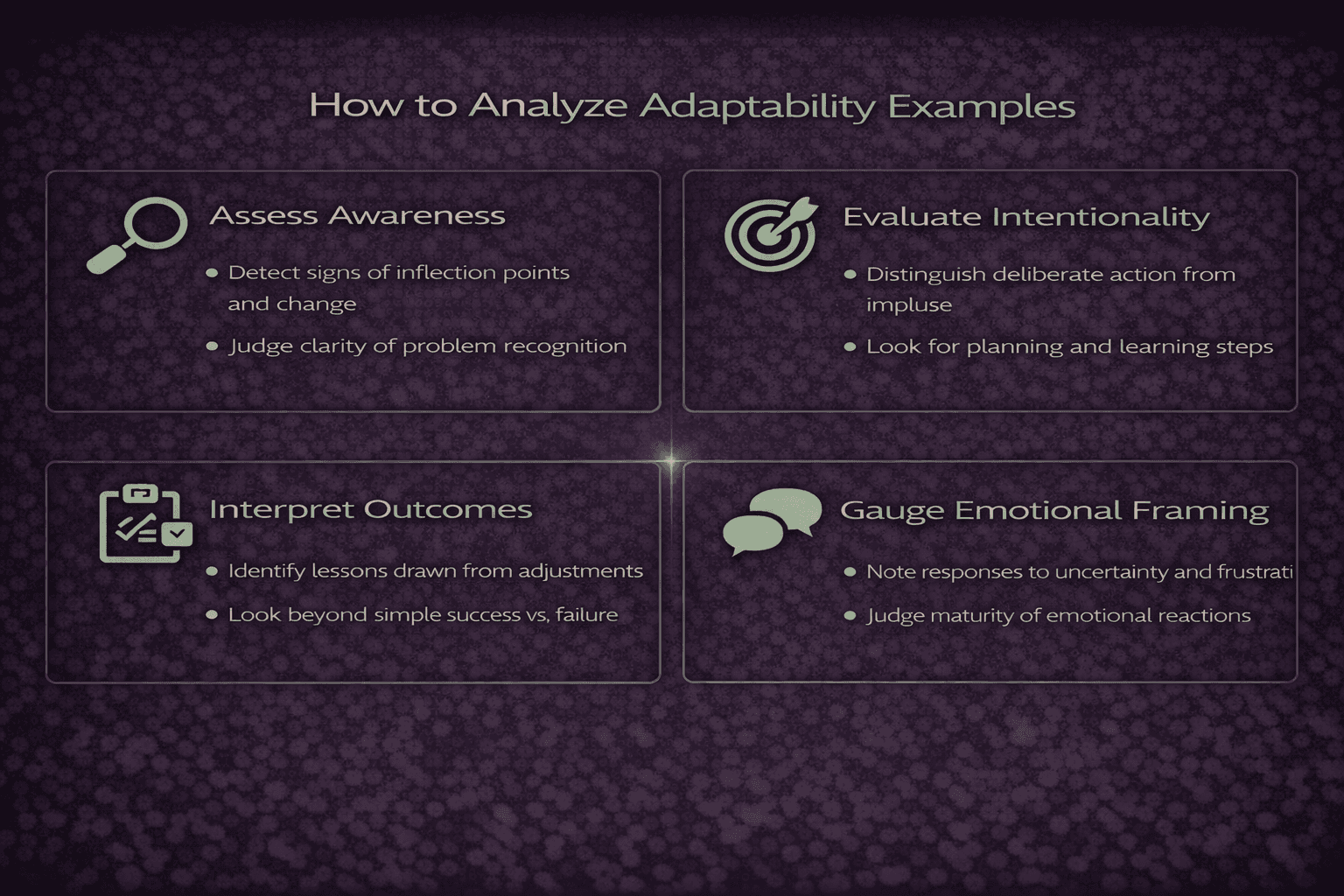
The second element is intentionality. Recruiters should examine whether the candidate acted deliberately or reacted impulsively. High-quality adaptability examples include descriptions of planning, consultation, experimentation, and reflection, rather than rushed decisions driven by frustration.
Outcome interpretation is another critical dimension. Instead of presenting success as inevitable, adaptable professionals explain what they learned from both effective and ineffective actions. This reflective layer distinguishes growth-oriented candidates from those who simply recount events.
Recruiters also analyze emotional framing. Candidates who acknowledge discomfort, uncertainty, or doubt—while demonstrating how they managed these emotions constructively—signal maturity and resilience. Conversely, narratives that minimize difficulty or externalize blame often reveal limited adaptability.
Finally, consistency across multiple examples matters. When adaptability is a genuine trait, it appears in varied contexts rather than isolated incidents. By examining patterns in how candidates describe learning, adjustment, and resilience, recruiters gain a reliable forecast of how they will perform when future disruptions inevitably arise.
Trends and Innovations in Evaluating Adaptability
The evaluation of adaptability is moving rapidly away from intuition-based judgment toward structured, data-informed assessment models. One of the most significant innovations is the application of narrative analytics. Instead of simply listening for keywords such as “change” or “learning,” modern evaluation frameworks examine how candidates structure their stories about disruption. Recruiters analyze whether candidates recognize inflection points, explain why prior strategies failed, and articulate the logic behind new approaches. This narrative depth is emerging as a core indicator of learning agility.
Artificial intelligence is also reshaping adaptability assessment. According to analysis highlighted by Forbes, AI-driven communication analysis now enables recruiters to detect patterns in how candidates describe uncertainty, failure, and iteration. These systems evaluate coherence, emotional framing, and clarity, helping organizations identify individuals who do not merely tolerate change but actively learn from it.
Another innovation is the use of simulation-based adaptability scenarios. Instead of relying exclusively on retrospective examples, organizations present candidates with evolving case studies that require on-the-spot adjustment. These simulations reveal how candidates respond to ambiguity in real time, offering deeper insight than static interview questions.
Remote-first hiring has accelerated the need for adaptability measurement in virtual contexts. Recruiters now assess how candidates describe shifts to asynchronous work, cross-time-zone collaboration, and digital tool adoption. Platforms such as Tener AI support this trend by analyzing spoken English clarity in adaptation-focused narratives, enabling global teams to evaluate both behavioral and communication readiness.
Finally, longitudinal evaluation models are emerging. Rather than assessing adaptability at a single interview stage, organizations track how candidates respond to change across multiple interactions, building a composite adaptability profile that evolves over the hiring lifecycle.
Trend | What It Enables | Recruiter Benefit | Hiring Outcome |
|---|---|---|---|
Narrative analytics | Story structure analysis | Deeper learning agility insight | More accurate hiring decisions |
AI communication analysis | Emotional framing detection | Objective evaluation | Reduced bias |
Simulation scenarios | Real-time adaptability testing | Behavioral validation | Lower onboarding risk |
Remote adaptability metrics | Virtual collaboration assessment | Global talent readiness | Stronger distributed teams |
Longitudinal profiling | Multi-stage adaptability view | Consistent signal tracking | Higher quality of hire |
How Businesses Can Use Adaptability Examples
Organizations that successfully embed adaptability examples into hiring do so by redefining what they consider evidence of readiness. Instead of treating adaptability as a vague personality trait, they translate it into observable behaviors that can be evaluated consistently. This begins with aligning adaptability questions to the realities of the role. For positions affected by frequent change—such as product management, customer success, or operations—interview frameworks are designed to surface moments when candidates had to abandon familiar routines and build new ones under pressure.
Adaptability examples are most powerful when they are examined at multiple points in the hiring process. Early interviews may focus on learning agility and response to uncertainty, while later stages explore leadership through disruption or resilience in prolonged change. This layered approach reduces the likelihood that candidates can rely on rehearsed narratives and instead highlights genuine behavioral patterns.
Technology plays a critical role in operationalizing this method. Rather than manually comparing narratives, hiring teams increasingly rely on AI-supported tools to analyze clarity, reflection depth, and consistency across examples. Tener AI contributes to this process by evaluating how clearly candidates articulate adaptation stories in spoken English, enabling global teams to make objective assessments regardless of interviewer location.
Finally, organizations must reinforce adaptability evaluation after hiring. When interview data is compared with onboarding feedback, performance reviews, and retention metrics, companies learn which adaptation behaviors predict success in their environment. Over time, adaptability examples evolve from interview artifacts into strategic indicators that shape workforce planning and leadership development.
Summary Table
Section | Focus Area | Key Insight | Strategic Value |
|---|---|---|---|
Definition | Response to change | Reveals learning agility | Better long-term fit |
Importance | Uncertainty readiness | Predicts future performance | Reduced turnover |
Core Benefits | Behavioral evidence | Shows growth mindset | Higher quality hires |
Industry Examples | Contextual application | Sector-specific relevance | Cultural alignment |
Types | Learning, behavioral, situational | Multiple adaptability dimensions | Holistic evaluation |
Evaluation Trends | AI-driven analysis | Objective adaptability metrics | Lower hiring risk |
Business Integration | Structured interviewing | Adaptability as a competency | Sustainable hiring strategy |
Conclusion
Adaptability examples provide one of the clearest indicators of how candidates will perform when circumstances inevitably change. While technical expertise reflects what a person can do under ideal conditions, adaptability reveals how that performance is sustained when priorities shift, systems fail, or expectations evolve. In today’s dynamic business environment, this capacity to recalibrate quickly is not a secondary skill—it is a foundational requirement.
By focusing on real experiences of change, organizations move beyond surface-level assessments and into a deeper understanding of learning agility, resilience, and reflective thinking. These qualities shape how employees respond to ambiguity, support colleagues through disruption, and contribute to continuous improvement. When adaptability examples are evaluated systematically and reinforced with AI-supported communication analysis such as that provided by Tener AI, hiring teams gain a reliable, scalable framework for predicting long-term success.
Ultimately, companies that prioritize adaptability do more than fill roles. They build workforces capable of evolving alongside the organization, turning uncertainty into momentum rather than friction.
FAQ
What are adaptability examples?
They are detailed stories that demonstrate how an individual responded to change, learned new skills, or adjusted behavior when circumstances shifted.
Why are adaptability examples important in hiring?
Because they predict how candidates will perform in environments where priorities, tools, and expectations evolve frequently.
How should candidates present adaptability examples?
By clearly explaining the situation, the change they faced, the actions they took, and what they learned from the experience.
Can adaptability be measured objectively?
Yes. When combined with structured interviews and AI-supported analysis of narrative clarity and reflection depth, adaptability can be evaluated with consistency.
Which roles benefit most from adaptability assessment?
Roles in technology, healthcare, education, finance, and remote-first organizations benefit the most due to constant operational change.
How do companies use adaptability examples after hiring?
They compare interview adaptability signals with onboarding and performance outcomes to refine hiring criteria and support leadership development.

" height="80.94400020599366px" id="qIjvZtSLI" transform="translate(0 12.275)" width="373.7409916992187px"/><path d="M 0 9.975 C 0 7.247 0.974 4.902 2.919 2.942 C 4.949 0.981 7.361 0 10.152 0 C 12.858 0 15.228 0.938 17.259 2.814 C 19.287 4.689 20.302 6.991 20.302 9.719 C 20.302 12.447 19.287 14.791 17.259 16.752 C 15.311 18.712 12.943 19.692 10.152 19.692 C 8.799 19.692 7.488 19.437 6.219 18.926 C 5.054 18.427 3.982 17.735 3.046 16.88 C 2.101 16.007 1.326 14.966 0.761 13.81 C 0.251 12.596 -0.008 11.292 0 9.975 Z" fill="rgb(34, 191, 89)" height="19.691999999999993px" id="yONhdWkLI" transform="translate(289.772 72.503)" width="20.30220185337174px"/><path d="M 15.225 0.001 L 0 0.001 L 0 61.38 L 15.225 61.38 L 15.225 0 Z" fill="rgb(245, 245, 245)" height="61.38px" id="D4KrqKylr" transform="translate(387.929 30.049)" width="15.225000000000023px"/><path d="M 0 9.207 C 0 6.735 0.888 4.603 2.664 2.813 C 4.526 0.938 6.852 0 9.643 0 C 12.435 0 14.761 0.895 16.622 2.685 C 18.567 4.39 19.541 6.565 19.541 9.207 C 19.541 11.85 18.567 14.066 16.622 15.857 C 14.761 17.561 12.435 18.414 9.643 18.414 C 6.852 18.414 4.526 17.518 2.664 15.728 C 0.888 13.853 0 11.679 0 9.207 Z" fill="rgb(245, 245, 245)" height="18.414px" id="Qi52r923l" transform="translate(385.771 0)" width="19.54099999999994px"/></g></svg>)